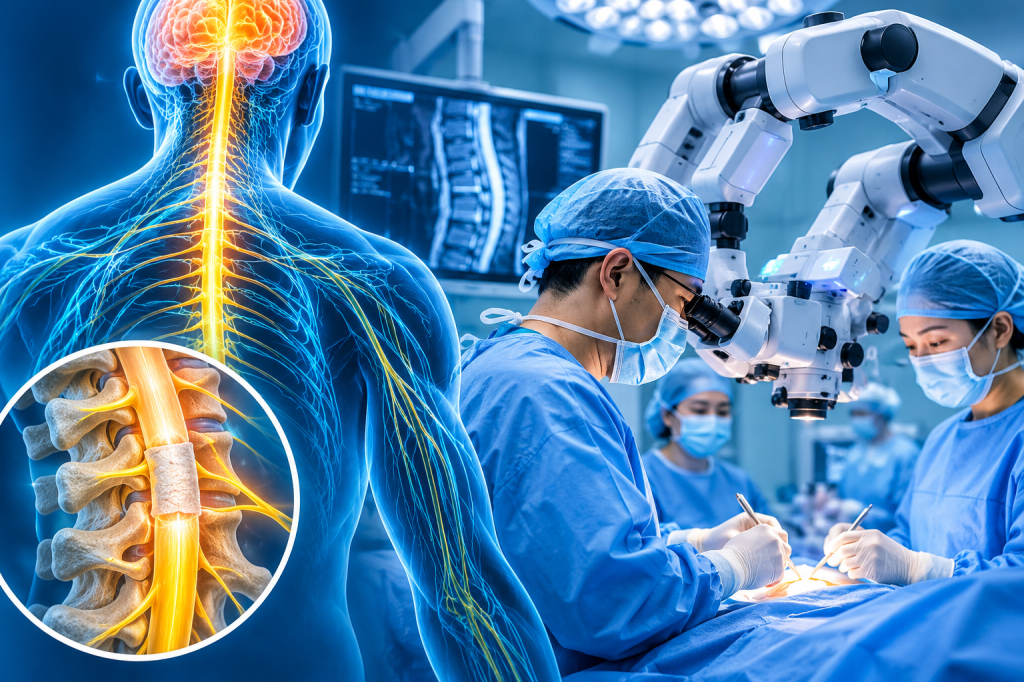
An extraordinary 12-hour operation in Moscow raises questions about the future of spinal cord repair, medical innovation and the responsibilities of experimental surgery.
A Remarkable Operation in Moscow
In October 2026, an international surgical team involving Chinese and Russian specialists reported performing an extraordinary operation: replacing a damaged section of a patient’s spinal cord with tissue obtained from a deceased donor.
The procedure took place at Moscow’s Sklifosovsky Research Institute for Emergency Medicine on 14–15 October and lasted approximately 12 hours.
Chinese surgeon Ren Xiaoping, associated with the Second Affiliated Hospital of Guangxi University of Chinese Medicine, described the operation as a pioneering attempt at human spinal cord transplantation.
The development attracted international attention following reports in the South China Morning Post and New Scientist.
But the significance of the operation cannot yet be measured by the surgery alone.
The central question is whether transplanted spinal cord tissue can restore meaningful communication between the brain and the body.
That remains unproven.
What Did the Surgeons Attempt?
According to published accounts, the patient had experienced a complete traumatic spinal cord injury approximately three years earlier.
The surgical team reportedly removed a damaged section of the spinal cord and replaced it with donor spinal cord tissue.
Surgeons used microsurgical techniques and polyethylene glycol (PEG), a substance investigated for its ability to help damaged cell membranes reconnect.
The underlying concept is that bringing nerve tissue into close contact, with assistance from PEG, might help establish connections across an injury.
However, the human spinal cord is not a simple cable that can be cut and rejoined.
It contains complex networks of nerve fibres responsible for transmitting signals associated with movement, sensation and numerous bodily functions.
Successful repair would require more than physical attachment. Functional connections would need to develop or be restored between the recipient’s existing neural pathways and the transplanted tissue.
This is one of the greatest challenges in neuroscience.
Why Spinal Cord Injuries Are So Difficult to Treat
Unlike many other tissues, the adult central nervous system has a limited capacity to regenerate after severe injury.
Damage to the spinal cord can interrupt communication between the brain and areas of the body below the injury.
The consequences may include paralysis, loss of sensation and disturbances affecting bladder, bowel and other functions.
Over time, additional biological changes can complicate recovery. These include scar formation, tissue degeneration and molecular processes that inhibit nerve regeneration.
This is why repairing a spinal cord injured several years earlier presents different challenges from attempting to reconnect recently severed nerve tissue.
Experimental research has explored cell transplantation, electrical stimulation, biomaterials, rehabilitation technologies and other approaches.
Yet none of these developments establishes that transplantation of a mature donor spinal cord segment can reliably restore neurological function in humans.
What Has Actually Been Achieved?
The reported completion of such an operation is scientifically noteworthy.
Russian officials publicly acknowledged the surgery, while Ren reported that the patient was stable following the procedure.
However, postoperative stability is not the same as neurological recovery.
As of early November 2026, the available public reports do not establish that the patient has regained movement, sensation or other meaningful neurological function because of the transplant.
Detailed clinical results, neurological assessments and independently reviewed evidence have not yet been made publicly available.
The distinction matters.
A technically completed experimental procedure may represent a step in surgical exploration without demonstrating that the underlying treatment works.
Further information will be necessary before its clinical significance can be assessed.
Independent Scientists Urge Caution
The operation has also prompted substantial criticism from researchers specialising in spinal cord injury.
Neuroscientist Melissa Andrews, of the University of Southampton, has questioned whether the potential benefits justify the risks associated with such extensive surgery.
These concerns include infection, additional injury and the possibility that the intervention may provide little or no functional improvement.
Andrew Jackson, a professor at Newcastle University, has acknowledged that PEG-related research offers some scientific interest while emphasising the difficulty of establishing functional connections between mature nervous-system tissues.
Their concerns highlight the difference between an experimental biological concept and a clinically demonstrated treatment.
For a development of this importance, independent evaluation, transparent reporting and longer-term patient follow-up are essential.
Further discussion of these concerns appears in International Hospitals & Healthcare Review and New Atlas.
China, Russia and the Changing Geography of Medical Innovation
The operation also illustrates the increasingly international character of advanced medical research.
Chinese specialists participated in a procedure conducted at a Russian medical institution, bringing together surgical experience and experimental techniques developed through earlier research.
China has become an important participant in several areas of advanced medical technology, including functional neurosurgery, medical robotics, neural interfaces and precision medicine.
These fields deserve serious international attention.
However, medical innovation must be evaluated according to the strength of its evidence rather than the nationality of the researchers or the scale of publicity surrounding a procedure.
For patients, the important questions remain consistent: What benefits have been demonstrated? What are the risks? What independent evidence is available? And what follow-up care will be required?
Where Does Medical Robotics Fit Into This Story?
Although the Moscow operation involved advanced microsurgery, it has not been established as a robotic surgical procedure.
Nevertheless, the story belongs within a wider discussion of technologies transforming modern surgery and neurological rehabilitation.
Robotic-assisted surgery can support precision and control in selected procedures. Rehabilitation robots and powered exoskeletons are being investigated and used in various clinical settings to support movement training. Neural interfaces and electrical stimulation systems are also expanding research into the restoration of lost function.
These technologies differ substantially in their maturity, clinical evidence and availability.
Some have established clinical applications. Others remain experimental.
A future examination of Medical Robotics & Advanced Surgical Technologies should distinguish carefully between these categories rather than treating all innovation as equivalent.
What Does This Mean for International Patients?
For individuals living with spinal cord injuries, reports of experimental procedures can generate considerable hope.
That hope deserves to be treated responsibly.
At present, the reported China–Russia spinal cord transplant should be regarded as an experimental intervention, not an established treatment for paralysis.
Patients and families should not interpret the reported surgery as evidence that spinal cord transplantation is clinically available, effective or appropriate for medical travel.
Before considering any experimental intervention, patients should seek independent specialist advice and request information about ethical approval, published evidence, foreseeable risks, rehabilitation requirements and long-term follow-up.
Medical innovation is important. So is protecting patients from premature claims.
An Important Story — With an Unwritten Conclusion
The reported operation in Moscow may eventually contribute to our understanding of spinal cord repair.
Alternatively, further evidence may show that the technique cannot deliver the functional improvements its advocates hope to achieve.
For now, both possibilities remain open, although substantial scientific obstacles have been identified.
The most important next development will not be another dramatic headline.
It will be the publication of reliable clinical evidence showing what happened to the patient after surgery.
Until then, the operation is best understood as a controversial experimental frontier — not a proven medical breakthrough.
Further Reading
- South China Morning Post — Ren Xiaoping completes spinal surgery in Russia
- New Atlas — World-first spinal cord transplant claim raises serious questions
- International Hospitals & Healthcare Review — Surgeons report first human spinal cord transplant amid safety concerns
Editorial Note
This article examines a reported experimental medical procedure using publicly available reporting and independent scientific commentary as of 3 November 2026. It does not endorse spinal cord transplantation as a proven treatment or recommend any experimental procedure to patients. Clinical claims should be reassessed as independently reviewed evidence becomes available.


Leave a Reply