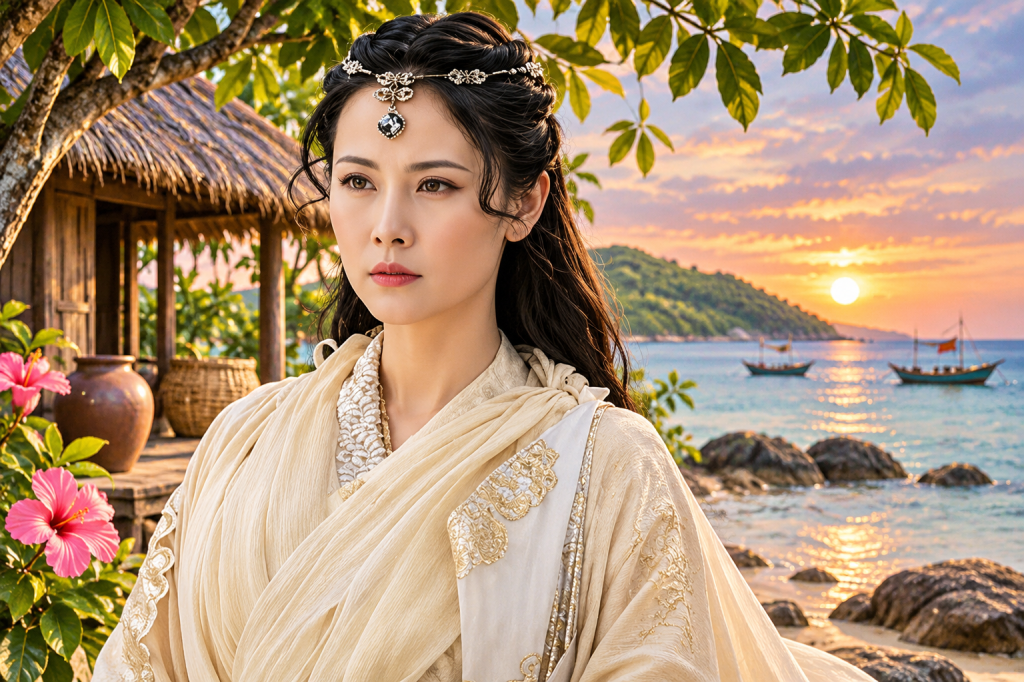
The legend of a royal refugee, the opening of an island frontier, and a woman whose memory survives in the shrines and traditions of southern Vietnam.
Today, Phú Quốc is celebrated for its tropical beaches, turquoise waters, luxury resorts and increasingly international reputation as a holiday destination.
Yet beyond the island’s modern developments lies another Phú Quốc — one shaped by migration, maritime trade, agricultural settlement and stories passed from one generation to another.
Among those stories is the remarkable legend of Bà Kim Giao, a woman traditionally remembered as one of the island’s earliest pioneers.
Her story reaches beyond Vietnam, towards the royal traditions of Cambodia, and intersects with the turbulent history of Nguyễn Ánh, the future Emperor Gia Long.
Although much of her biography remains uncertain, the memory of Bà Kim Giao has survived in local place names, religious traditions and the communities of Phú Quốc.
A Woman from Across the Sea
According to local folklore, Bà Kim Giao belonged to the royal family of Chân Lạp, the historical Khmer kingdom associated with parts of present-day Cambodia.
The story tells of political upheaval that forced her to leave her homeland and seek refuge across the sea on Phú Quốc.
The island offered both isolation and opportunity.
Rather than remaining simply a refugee, she is said to have established a settlement, brought buffalo with her and organised the cultivation of land.
Her followers cleared fields, developed agricultural activities and helped establish a community in what was then a sparsely populated island landscape.
The historical details of this account cannot be independently confirmed. Nevertheless, the legend reflects the longstanding connections between the island and the neighbouring Cambodian coast.
The Phú Quốc local government’s account of the island’s legends preserves these traditions and describes Bà Kim Giao’s association with early agricultural settlement.
The Fields of Bà Kim Giao
One of the most intriguing elements of the legend is its connection with the physical landscape.
Local tradition associates Bà Kim Giao with an area known as Đồng Bà, meaning the Lady’s Fields.
These fields are remembered as places where agricultural cultivation and buffalo grazing took place.
Stories also describe surviving traces of wooden posts associated with former animal enclosures.
Another important location is Búng Dinh Bà, beside the Cửa Cạn River, where she is said to have established her residence or encampment.
These place names are significant because they demonstrate how a remembered individual can become part of a community’s geographical identity.
They do not, however, establish the precise date or circumstances of her life.
The story of Bà Kim Giao belongs to a much broader history of Phú Quốc’s settlement, involving Vietnamese, Khmer, Chinese and other communities connected through the maritime world of the Gulf of Thailand.
Historical accounts of the island’s population make clear that its development cannot be attributed to a single person or community.
Bà Kim Giao and the Future Emperor Gia Long
Another tradition links Bà Kim Giao with one of the most important figures in Vietnamese history: Nguyễn Ánh.
During the late eighteenth century, Nguyễn Ánh struggled against the Tây Sơn forces and sought refuge in several locations, including Phú Quốc.
He eventually defeated his rivals and established the Nguyễn dynasty in 1802, reigning as Emperor Gia Long.
According to island folklore, Bà Kim Giao supplied food to Nguyễn Ánh and his followers during a period when they were sheltering on Phú Quốc.
The story creates a fascinating connection between a woman remembered for developing the island’s agricultural resources and a future emperor struggling to survive.
However, the specific claim that Bà Kim Giao personally assisted Nguyễn Ánh remains a traditional account rather than an independently verified historical event.
Nguyễn Ánh’s presence on Phú Quốc is much better documented.
Research by Vietnam’s National Archives concerning Nguyễn dynasty records and Phú Quốc illustrates how archival evidence can sometimes clarify stories that have survived primarily through folklore.
The distinction matters. It allows us to appreciate the legend without presenting every detail as established history.
From Pioneer to Guardian Spirit
Over time, Bà Kim Giao became more than a remembered settler.
In local religious tradition, she is associated with Thủy Long Thánh Mẫu, a revered maternal guardian figure connected with the island and its waters.
Her memory is preserved through shrines known as Dinh Bà.
The Cửa Cạn area contains a shrine associated specifically with Bà Kim Giao, while another Dinh Bà is located near Dương Đông.
Local accounts sometimes distinguish these sites as Dinh Bà Trong and Dinh Bà Ngoài.
The relationship between Bà Kim Giao and Thủy Long Thánh Mẫu is described differently across local traditions, illustrating how historical memory and religious belief have developed together.
The shrines remain important expressions of community identity.
Visitors may see them as places of worship, but for local residents they also represent continuity with the generations who established and sustained life on the island.
Remembering Bà Kim Giao Today
Traditional ceremonies honouring Bà Kim Giao and Thủy Long Thánh Mẫu remain part of Phú Quốc’s cultural calendar.
Local accounts describe observances around the fifteenth day of the first lunar month, when communities gather to remember the figure associated with the island’s early development.
These occasions express gratitude, respect for ancestors and the continuing importance of local spiritual traditions.
The island’s Thủy Long Thánh Mẫu festival is one example of how her memory continues to be celebrated.
Such traditions are particularly important at a time when Phú Quốc is undergoing rapid development.
Modern tourism has transformed much of the island, but its shrines, fishing communities, traditional place names and historical stories offer another way of understanding its identity.
A Woman Between History and Legend
Was Bà Kim Giao a Cambodian princess who fled political turmoil?
Did she establish agricultural settlements along the Cửa Cạn River?
Did she provide food to Nguyễn Ánh during his struggle against the Tây Sơn?
These questions remain difficult to answer with historical certainty.
What can be established is that her story has been preserved through local traditions, place names, shrines and continuing religious observances.
Her legend also reflects the wider history of movement between the Cambodian coast and southern Vietnam, and the importance of agriculture and settlement in the development of island communities.
Perhaps the most remarkable aspect of her story is that a woman whose life cannot be reconstructed with confidence has nevertheless remained an enduring figure in Phú Quốc’s cultural memory.
Her legacy survives not in an imperial chronicle, but in the stories of the people who remember her.
Discovering the Cultural Heritage of Phú Quốc
For visitors, Phú Quốc offers far more than beaches and resorts.
Its history includes traditional fishing communities, coastal shrines, the legacy of Nguyễn Ánh, resistance to French colonial rule and the difficult memories preserved at Phú Quốc Prison.
The legend of Bà Kim Giao adds another dimension: the story of a woman associated with the island’s earliest agricultural traditions and its connections across the Gulf of Thailand.
To explore the island’s landscapes, cultural attractions, wellness opportunities and extended-stay options, visit our companion destination guide:
Phú Quốc Island — Wellness, Cultural Heritage and Extended Stays | Medical Tourism Vietnam
Editorial Note
Bà Kim Giao is a figure preserved in Phú Quốc’s historical traditions and folklore. Accounts of her royal ancestry, migration, agricultural activities and association with Nguyễn Ánh are presented as traditional narratives, not independently verified biographical facts.
The accompanying portrait is an original artistic interpretation and should not be understood as an authentic historical likeness.
Hanoi Trading Post — Exploring Vietnam’s history, culture, traditions and contemporary society.


Leave a Reply