Where mythology meets one of Vietnam’s most extraordinary natural landscapes.
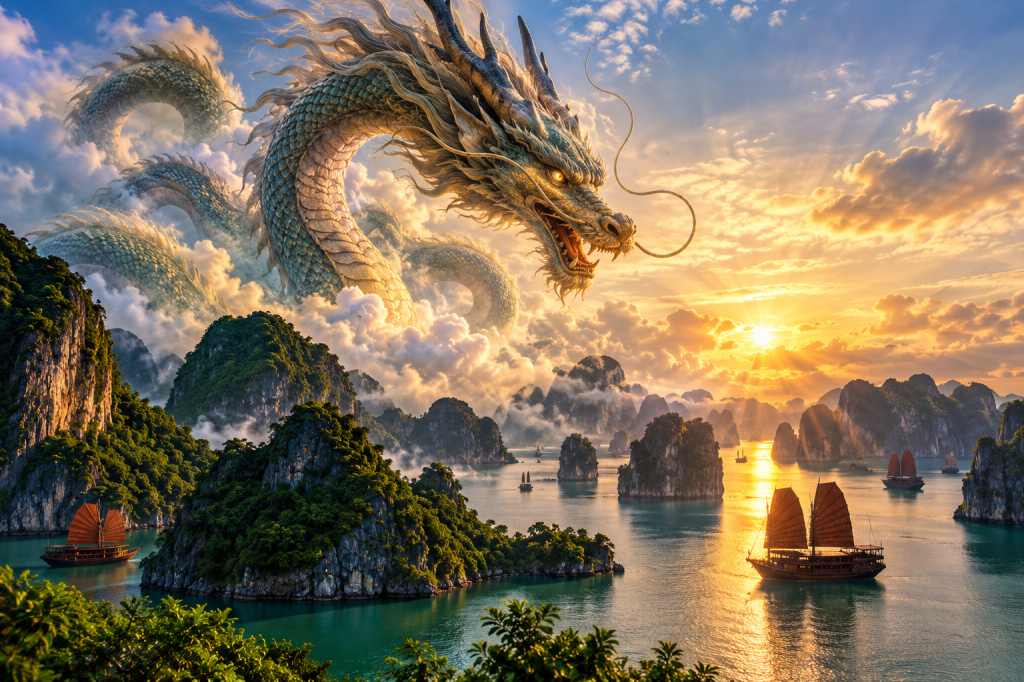
Across the waters of northern Vietnam, thousands of limestone islands rise from the sea, their forested peaks reflected in the changing colours of Hạ Long Bay. To the modern visitor, the landscape is a natural wonder. To generations of Vietnamese storytellers, however, it has also been the setting of an extraordinary legend — one involving dragons, precious jewels and the defence of a nation.
The name Hạ Long translates as Descending Dragon. It is a name that invites us to look beyond the scenery and into the mythology that has helped shape Vietnam’s cultural identity.
When Dragons Descended from Heaven
According to a traditional account of the legend, Vietnam faced an invasion in the distant past. To protect the people, the Jade Emperor sent a Mother Dragon and her offspring from the heavens.
The dragons descended towards the coast, scattering precious jewels and stones across the sea. As these treasures touched the water, they transformed into towering islands and rocky barriers.
The newly formed islands obstructed the invading fleet, protecting the coastline and helping the Vietnamese people defend their homeland.
When the danger had passed, the dragons remained in the region. The place where the Mother Dragon descended became known as Hạ Long — the Descending Dragon.
Like many traditional stories, the legend exists in different retellings. Its significance lies not in historical verification but in the relationship it creates between the Vietnamese people, their landscape and their cultural memory.
For visitors wishing to experience the setting of this remarkable story, Medical Tourism Vietnam’s Hạ Long Bay destination guide introduces the bay’s natural beauty, accommodation, wellness experiences and regional attractions.
The Dragon in Vietnamese Culture
The dragon, or rồng, occupies a special place in Vietnamese mythology.
Unlike the destructive creatures often encountered in European folklore, the Vietnamese dragon has traditionally been associated with water, rainfall, prosperity, protection and royal authority.
In an agricultural society dependent on seasonal rains and fertile land, the dragon’s relationship with water carried particular significance.
The dragon also became one of the four sacred creatures of Vietnamese tradition, alongside the qilin, tortoise and phoenix.
Its image appears throughout Vietnamese cultural history — in temples, communal houses, royal architecture, ceramics and ceremonial objects.
The Vietnam National Museum of History traces the development of dragon imagery across successive dynasties, illustrating how its appearance and symbolism changed over the centuries.
Children of the Dragon and Grandchildren of the Fairy
Vietnamese dragon mythology extends far beyond Hạ Long Bay.
One of the country’s foundational legends tells of Lạc Long Quân, a dragon lord associated with the sea, and Âu Cơ, a fairy associated with the mountains.
According to the traditional story, their union produced one hundred children. Fifty accompanied their father towards the sea, while the others followed their mother into the mountains.
The legend offers a symbolic explanation of the Vietnamese people’s shared ancestry despite their geographical diversity.
The familiar expression Con Rồng, cháu Tiên — Children of the Dragon, Grandchildren of the Fairy — continues to reflect this traditional understanding of national origins.
As described in the Vietnamese Government’s account of dragon symbolism, the dragon has long represented more than royal authority. It is also closely connected with ideas of ancestry, cultural identity and national belonging.
From the Descending Dragon to the Rising Dragon
Vietnamese history and folklore offer another fascinating connection between dragons and place names.
In 1010, King Lý Thái Tổ transferred the royal capital to the area that would become modern Hà Nội.
According to tradition, the king witnessed a golden dragon rising into the sky. Interpreting this as an auspicious sign, he named the new capital Thăng Long — Rising Dragon.
Thus, two of northern Vietnam’s most celebrated places carry complementary names:
Hạ Long — Descending Dragon, associated with the sea and its limestone islands.
Thăng Long — Rising Dragon, associated with the ancient capital and the emergence of royal power.
These names connect geography, political history and cultural imagination in a particularly Vietnamese way.
Visitors exploring the region can also discover the historical and cultural attractions of Hà Nội through Medical Tourism Vietnam’s destination guide.
A Landscape That Keeps Its Legend Alive
Today, Hạ Long Bay is internationally recognised for its remarkable limestone formations, sheltered waters and distinctive coastal scenery.
Yet its legendary name gives the landscape another dimension.
A solitary island rising through the morning mist may resemble the back of a sleeping dragon. A chain of limestone peaks stretching across the horizon can suggest the scattered jewels of the ancient story.
These are imaginative interpretations, of course, but they illustrate why folklore remains meaningful long after the origins of a story have been forgotten.
For travellers, understanding the legend adds something that photographs alone cannot provide: a sense of connection with the people who have lived beside these waters and interpreted their surroundings through stories passed from one generation to another.
Preserving Vietnam’s Stories
Vietnam’s folklore is part of its cultural heritage.
Its legends speak of the relationship between people and nature, the importance of family and ancestry, and the enduring desire to protect one’s homeland.
The Descending Dragon of Hạ Long Bay is one such story.
Whether encountered in traditional storytelling, artistic representations or the spectacular landscape itself, the dragon remains a powerful symbol of Vietnam’s cultural imagination.
And perhaps that is the enduring attraction of Hạ Long Bay: beneath its extraordinary natural beauty lies a story that continues to connect the landscape with the nation’s past.
Editorial Note: This article explores Vietnamese folklore and cultural traditions. The legends described are presented as mythology, not verified historical events. The accompanying dragon illustration is an artistic interpretation.
Further Reading: Explore Hạ Long Bay — Destinations, Wellness and Extended Stays | Medical Tourism Vietnam.


Leave a Reply