Academic expectations, family support and the wellbeing of young people in Vietnam
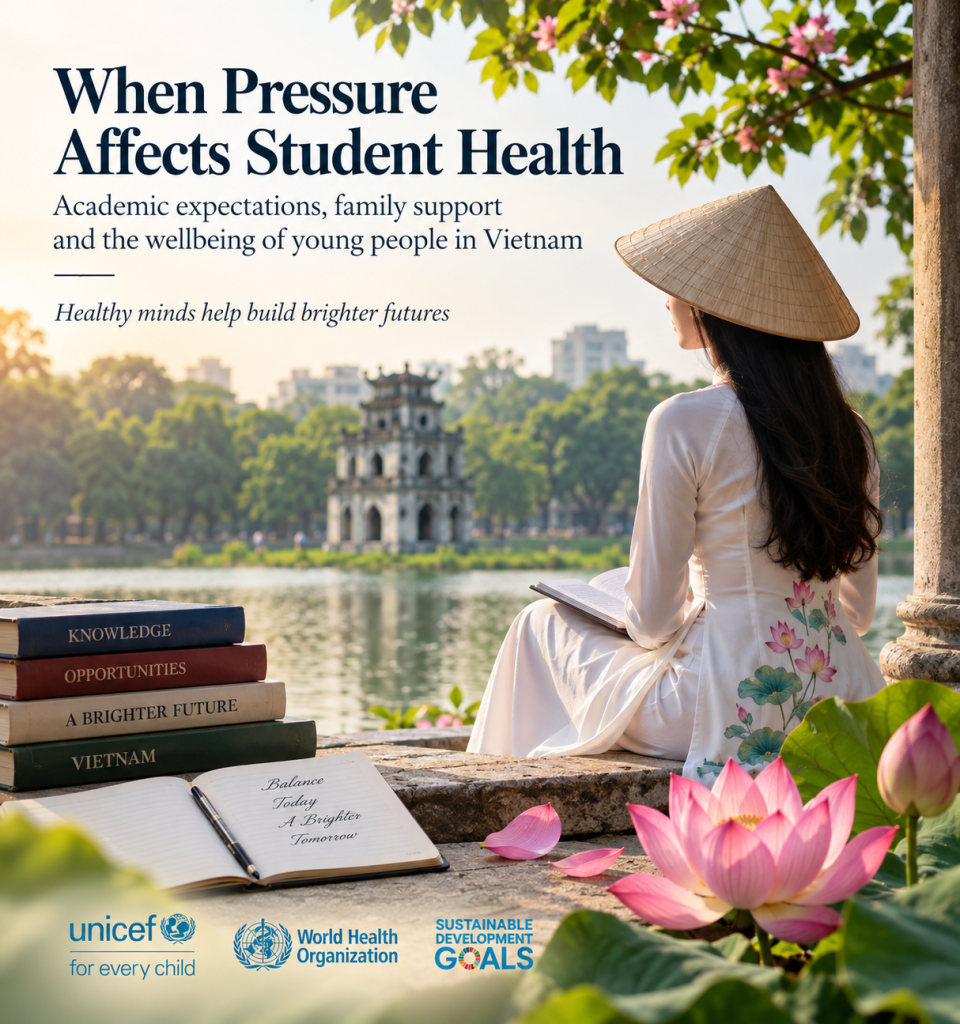
Education has long occupied an important place in Vietnamese family life. Academic achievement can represent much more than a school grade: it may be associated with opportunity, family pride, economic security and hopes for a better future.
For many parents, encouraging a child to study hard is therefore an expression of care.
But there is another question worth asking:
When does encouragement become pressure, and when does that pressure begin to affect a young person’s health?
This is not an argument against academic ambition. Nor should ordinary examination stress automatically be described as a mental-health disorder.
It is an argument for recognising that physical health, emotional wellbeing and educational achievement are connected — and that a successful student can still be a student who is struggling.
Pressure Does Not Always Look Like a Mental-Health Problem
A young person may never say, “I have a mental-health problem.”
They may instead say they cannot sleep.
They may complain of headaches or stomach discomfort. They may become irritable, unusually quiet, exhausted or unable to concentrate. They may lose interest in friends or activities they previously enjoyed.
Sometimes the first visible sign is simply: “I don’t want to go to school.”
That distinction matters, particularly in societies where conversations about psychological health can still carry stigma.
UNICEF Viet Nam reports that one in five adolescents in Vietnam experiences mental-health challenges, while only a small proportion of parents recognise that their adolescent may need mental-health support. UNICEF also identifies pressured learning environments, violence, bullying and stressful life events among factors contributing to emotional and psychological distress in young people.
This suggests an important change in the conversation.
We do not always have to begin by asking whether a child has a psychiatric condition.
We can begin by asking:
How is this young person coping?
Academic Pressure Is a Health Issue Too
A comprehensive study conducted by UNICEF Viet Nam in cooperation with Vietnam’s Ministry of Education and Training examined school-related factors affecting adolescent mental health and wellbeing.
It identified school climate, academic pressure, relationships with teachers and peers, and bullying among factors that can affect students’ wellbeing. It also emphasised that schools are not simply potential sources of stress: they can be important environments for prevention, protection and support.
That is an important distinction.
School is not the enemy.
Parents are not the enemy.
Academic achievement is not the enemy.
The issue is what happens when expectations become so intense that a young person’s health begins to suffer.
The Parents’ Dilemma
It would be unfair to discuss academic pressure in Vietnam without acknowledging why many parents place such importance on education.
Parents may have experienced economic hardship themselves. They may see university entrance, English proficiency or professional qualifications as pathways to opportunities they never had.
A mother asking her daughter to study another hour may not be trying to make her unhappy. A father worried about examination results may be thinking about his son’s future.
Those motivations can come from love.
But good intentions do not make families immune from pressure.
A useful question for parents may therefore be:
“Am I helping my child succeed, or has my child’s fear of disappointing me become part of the problem?”
Those are not the same thing.
A Good Grade Does Not Tell Us Everything
One of the dangers of equating academic performance with wellbeing is that high-performing students can be overlooked.
A student who continues receiving excellent grades may still be sleeping poorly, experiencing anxiety or believing that anything short of exceptional performance represents failure.
Achievement can sometimes conceal distress rather than disprove it.
The World Health Organization describes adolescence as an important period for developing emotional and social habits that support wellbeing, including healthy sleep, exercise, coping skills, problem-solving and learning to manage emotions. Supportive family, school and community environments are important protective factors.
That gives us a different way to think about educational success.
Good grades and good health should never have to compete with each other.
Teachers Often See What Others Do Not
Teachers occupy a particularly important position.
They see students repeatedly and may notice changes that are difficult for families to observe: declining concentration, unexplained absences, exhaustion, social withdrawal, sudden changes in behaviour or a previously engaged student becoming unusually quiet.
A teacher is not expected to diagnose a mental-health condition.
But a teacher can notice.
A teacher can listen.
And a teacher can help a student find an appropriate adult or professional when additional support appears necessary.
UNICEF’s research specifically describes schools as one of the most important psychosocial environments in adolescents’ lives and identifies school-based mental-health support as an important part of responding to school-related risks.
That makes student wellbeing part of education rather than something entirely separate from it.
Listening Before Judging
Adults naturally want to solve problems.
When a young person says, “I can’t do this anymore,” the immediate response may be:
You just need to try harder.
Everyone has exams.
You have nothing to worry about.
Think about your future.
Those responses may be intended as encouragement. But they can also end the conversation.
Sometimes a better first response is much simpler:
“Tell me what’s happening.”
Listening does not mean agreeing with everything a young person says. Nor does it mean abandoning expectations, discipline or responsibility.
It means understanding the problem before trying to solve it.
Bullying and the Online World
Academic expectations are only one part of student wellbeing.
Young people now move constantly between school life and digital life. Peer relationships, social comparison, online harassment and cyberbullying can follow students home in ways previous generations did not experience.
UNICEF reports that around one in five children and adolescents in Vietnam experience peer harassment or cyberbullying, while many do not know where to seek help.
A student struggling at school may therefore be dealing simultaneously with academic expectations, friendships, family expectations and an online social environment that parents and teachers cannot easily see.
Asking for Help Is Not Failure
Perhaps one of the most important messages adults can give young people is that asking for help is not an admission of weakness.
Mental wellbeing exists on a continuum.
A student does not need a psychiatric diagnosis before being allowed to say that life feels overwhelming.
Support may begin with a parent, teacher, trusted relative or school counsellor. At other times, professional counselling, psychological assessment or medical care may be appropriate.
WHO notes that stigma can affect whether adolescents are willing to seek help and emphasises prevention, supportive environments and access to appropriate mental-health care.
UNICEF and WHO’s joint Helping Adolescents Thrive initiative similarly focuses on promoting adolescent mental health and preventing mental-health conditions, rather than waiting until difficulties become severe.
Protecting Ambition Without Sacrificing Health
Vietnam should not have to choose between educational ambition and student wellbeing.
Young people can be encouraged to work hard.
Families can maintain high hopes.
Teachers can expect effort and responsibility.
Universities and employers can maintain standards.
But achievement becomes less meaningful if a young person reaches the destination physically exhausted, emotionally overwhelmed or believing that their value depends entirely upon their examination results.
The objective should not be to remove pressure from young people’s lives. That would be neither possible nor necessarily desirable.
The objective is to help them develop the resilience, relationships and support necessary to manage it.
And sometimes that begins with adults recognising when pressure has become too much.

A Message to Students
Your examination result matters.
Your education matters.
Your future matters.
But none of them represents the entirety of who you are.
If you are struggling, speaking to someone you trust is not making an excuse.
It is taking your health seriously.
And health — physical and psychological — is part of building the future you are studying so hard to achieve.
Further Information & Resources
For readers who would like to explore the evidence behind this article, these are particularly useful authoritative resources:
UNICEF Viet Nam — Mental Health
UNICEF Viet Nam — Study on School-Related Factors Impacting Adolescent Mental Health and Wellbeing
UNICEF Viet Nam — Vietnamese-language study and resources
UNICEF Viet Nam — Safe Learning Environments
World Health Organization — Adolescent Mental Health
WHO — Global School-based Student Health Survey: Viet Nam
Medical Tourism Vietnam — Vietnamese Resource
Our newly published Vietnamese-language guide complements this HTP feature and is particularly suitable for students, parents, families and teachers:
Sức Khỏe Tâm Thần ở Việt Nam: Hỗ Trợ Tâm Lý cho Trẻ Em, Thanh Thiếu Niên và Gia Đình
For the broader English-language resource:
Mental Health Support in Vietnam
Editorial Note
This article is intended to encourage informed discussion about student health, education and wellbeing. It does not suggest that normal academic stress constitutes a mental-health disorder, nor that academic expectations alone cause mental illness. Young people’s wellbeing is influenced by many interacting personal, family, educational and social factors.
Where a young person shows signs of serious distress, self-harm, suicidal thoughts or immediate danger, urgent professional or emergency medical assistance should be sought.
About the Author
George Adams writes on education, healthcare, Vietnam and social issues affecting communities across Asia.
Last reviewed: September 2026
 Hanoi Trading Post
Leave a comment