The real questions are quality, cost and convenience — not nationality.
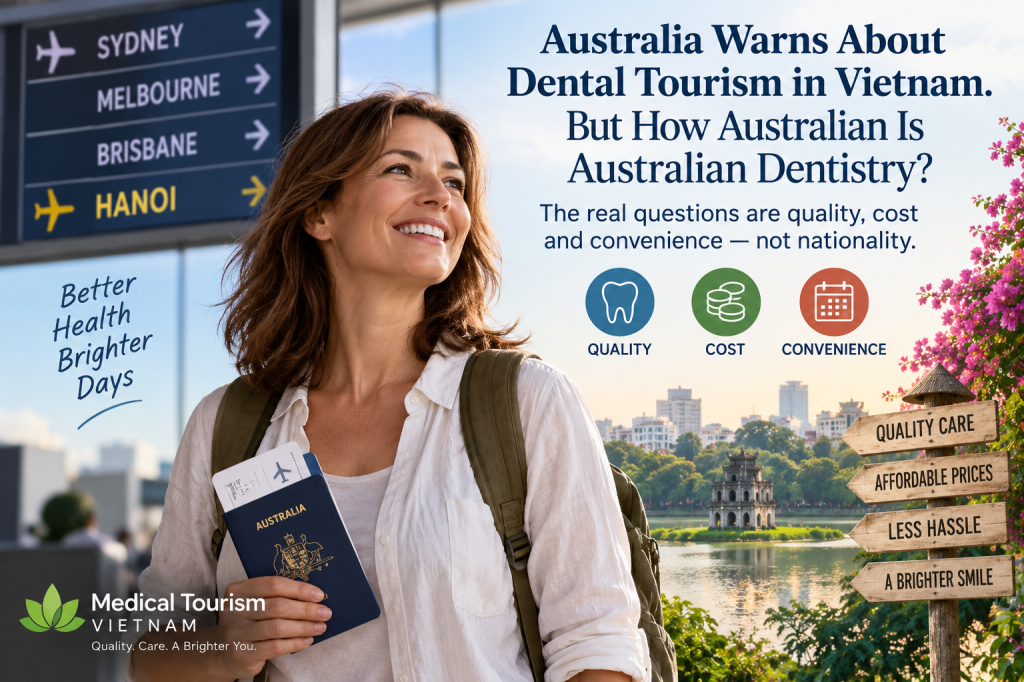
The ABC’s recent report, “Vietnam wants to grow dental tourism. It has Australian dentists worried” (6 September 2026), is a familiar story: Australians heading to Vietnam for treatment they cannot afford at home, while Australian dentists warn of rushed procedures and poor outcomes.
They have a point. Complex dentistry should not be compressed into a two-week holiday.
But that is an argument against rushed treatment — not an argument against Vietnam.
Modern dentistry is already global.
Implant systems, titanium components, zirconia, ceramics, digital scanners, milling technology and dental laboratory services move through international supply chains. South Korea is a major producer of dental implants. Osstem, Dentium and MegaGen operate internationally. China manufactures dental devices and prosthetic products on a massive scale.
Australia participates in this system too. The Therapeutic Goods Administration specifically provides guidance for Australian dentists obtaining personalised dental devices from overseas manufacturers — even using the example of an Australian dentist sending a patient’s casts to an overseas laboratory and importing the finished device.
There is nothing inherently wrong with that.
A dental implant does not have a nationality. Nor does a dental qualification.
The ABC report’s subtext is that Australian dentistry is safer because it is Australian. But walk into many clinics in Hanoi or Ho Chi Minh City and you may find a dentist who trained in Australia, the UK, the US, Russia or China. The question is not whether a dentist is Vietnamese or Australian. It is whether they are trained, experienced, and using appropriate technology and materials for the procedure being proposed.
Geography is not a proxy for competence.
Cheap dentistry is not the objective. Rushed dentistry is the problem.
Consultation should come first. Diagnosis should come first. The treatment plan should determine the itinerary — not the itinerary determine the treatment. An implant is inserted into living bone. Biological healing does not accelerate because a patient has booked a return flight for Friday.
The Australian specialists are right to question situations where complex treatment is compressed into a short dental holiday. But that is an argument against rushing. It is not an argument against Vietnam.
Quality matters. So does cost.
There is an uncomfortable tendency in medical tourism debates to treat price as though sophisticated patients shouldn’t mention it. Of course cost matters — to someone earning $50,000 and to someone earning $500,000. Being able to afford expensive treatment does not create an obligation to overpay for it.
The modern medical traveller is not searching for the cheapest dentistry. They are seeking a combination of clinical quality, technology, materials, service, convenience and cost that may be difficult to obtain at home.
Vietnam’s lower cost base is part of its competitive advantage. The question is what the patient receives for that price.
The real question is not where, but who and how.
Who is treating me? What implant system is being used? What materials? How much healing time is allowed? What happens afterwards? What will it cost?
Those are reasonable questions in Hanoi or Ho Chi Minh City.
But they are equally reasonable in Brisbane, Sydney or Melbourne.
Modern dentistry is international. Good clinicians exist in many countries. So do poor clinical decisions. Vietnam does not need to argue that every dentist within its borders is excellent. No country could honestly make that claim.
Instead, Vietnam’s opportunity is more compelling. It can compete for informed international patients on quality, cost and convenience.
The patient in the ABC report spent roughly one-third of the Australian quote, including flights and accommodation, and described the result as life-changing. That doesn’t prove every Vietnamese clinic is excellent. But neither should her decision be dismissed as an irresponsible search for cheap treatment.
If Australians are travelling thousands of kilometres for care they cannot afford at home, perhaps the better question is not why they leave — but what Australia can learn from why they stay away.
The informed medical traveller is not choosing between two flags.
They are choosing between clinicians, technologies, materials, treatment plans, standards of care and aftercare.
The question isn’t where the dentistry is performed. It is whether the dentistry is good — and whether the patient has asked enough questions to choose it well.
Further Information for Patients
For readers considering dental treatment in Vietnam, Medical Tourism Vietnam provides patient-focused information on dental care, treatment planning and travelling for healthcare.
The emphasis is on informed decision-making: understanding the proposed treatment, comparing providers, allowing appropriate time for treatment and recovery, and considering follow-up care before making travel arrangements.
Source: ABC News, “Vietnam wants to grow dental tourism. It has Australian dentists worried”, 6 September 2026.
Editorial Note — Vietnam’s Medical Tourism Development
The wider debate about healthcare quality, international patient confidence and Vietnam’s medical tourism ambitions extends beyond dentistry.
In September 2025, Vietnamese newspaper Kinh tế & Đô thị published an examination of Vietnam’s medical tourism opportunities, including commentary from Medical Tourism Vietnam on international experience, healthcare competitiveness and the importance of strengthening services for overseas patients.
The discussion highlights a central principle also reflected in this article: patients need reliable information, transparent treatment options and confidence in the quality of care, regardless of where treatment is provided.
Further reading: Vietnam’s Medical Tourism — International Experience as a Catalyst (Kinh tế & Đô thị, September 2025)


Leave a Reply