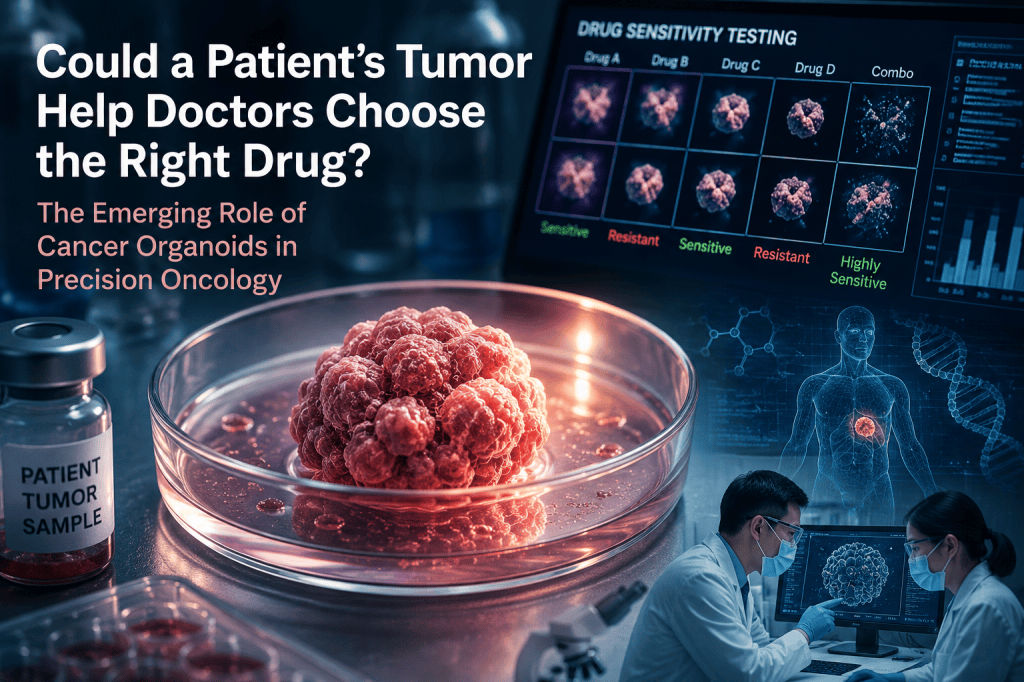
Scientists are learning how to grow miniature models of an individual patient’s tumor in the laboratory — and then expose those models to different cancer drugs. The technology could add another layer to personalised cancer treatment, particularly when conventional options are running out.
For decades, one of oncology’s most difficult problems has been deceptively simple: two patients can have apparently similar cancers, receive the same treatment, and experience very different outcomes.
One patient’s tumor may shrink dramatically. Another may show little response. A third may initially respond before becoming resistant.
Genomic testing has helped doctors understand some of these differences by identifying mutations and molecular characteristics that can make a tumor vulnerable to particular targeted treatments. But genetics does not always tell the whole story.
An emerging field known as functional precision oncology is approaching the problem differently.
Instead of asking only what mutations does this cancer contain?, researchers are increasingly asking another question:
What happens when this particular patient’s living tumor cells are actually exposed to different drugs?
One of the technologies making that possible is the patient-derived tumor organoid.
What Is a Tumor Organoid?
An organoid is a three-dimensional collection of cells grown under specialised laboratory conditions.
In cancer research, scientists can take cells from a patient’s tumor — obtained, where clinically appropriate, from surgery, biopsy or another suitable specimen — and attempt to grow them into a miniature three-dimensional model.
These models are sometimes described informally as “mini-tumors”, although the term needs qualification. An organoid is not a complete replica of a cancer growing inside the human body. Nevertheless, patient-derived organoids can preserve important biological, genetic and structural characteristics of the original tumor.
This makes them potentially more informative than conventional laboratory cancer cell lines.
Once an organoid has been successfully established, researchers can expose it to different anti-cancer drugs and combinations of drugs and observe how the tumor cells respond.
Bringing the Patient’s Tumor Into the Laboratory
The concept reverses part of the traditional drug-selection process.
Rather than giving several treatments to a patient sequentially and waiting to see which works, researchers can potentially test multiple possibilities against the patient’s tumor model outside the body.
The process may broadly involve:
- Obtaining an appropriate tumor sample.
- Isolating viable tumor cells.
- Growing patient-derived organoids under controlled laboratory conditions.
- Exposing the organoids to selected anti-cancer drugs or combinations.
- Measuring changes in tumor-cell survival or growth.
- Providing the findings to the treating oncology team as additional information for clinical consideration.
This does not mean that the laboratory can simply identify “the drug that will cure the patient.”
Human cancer is considerably more complicated.
But the results may provide another piece of evidence when oncologists are evaluating treatment choices.
Why Could This Matter?
The potential importance becomes particularly apparent in patients with recurrent, refractory or complex cancers.
A patient may already have undergone surgery, chemotherapy, radiotherapy, targeted therapy or other treatments. The cancer may have returned, stopped responding, or developed resistance.
At that point, treatment decisions can become increasingly difficult.
Genomic profiling may identify potentially actionable mutations, but it does not directly demonstrate how living tumor cells will react when exposed to a drug.
Organoid testing attempts to add that functional information.
Research in functional precision oncology suggests that patient-derived models can complement genomic information by helping scientists investigate the actual vulnerabilities of an individual tumor.
Studies have explored organoid-based drug testing in cancers including colorectal, pancreatic, gastric, lung and ovarian cancers, among others.
Testing More Than One Drug
Another intriguing aspect of organoid technology is the possibility of evaluating combinations.
Cancer treatment frequently involves more than one medicine. A combination may be more effective than either drug alone, but predicting the response of an individual tumor can be difficult.
Laboratory organoids can potentially be exposed to different concentrations and combinations of candidate therapies before a treatment decision is made.
This creates what researchers sometimes describe as a functional drug-response profile.
Rather than relying exclusively on what a cancer should respond to according to its molecular classification, doctors may gain additional evidence about how that particular tumor behaved under laboratory testing.
From Research Tool to Clinical Decision Support
Patient-derived organoids have already become important tools in cancer research and drug development.
Their potential use in individual clinical decision-making is more recent.
Research has produced encouraging results. Studies have demonstrated that organoids can retain important characteristics of the cancers from which they were derived, and some prospective investigations have shown that organoid drug-response testing can help inform treatment choices.
But this remains an evolving field.
Growing a usable organoid is not successful in every patient. Different laboratories may use different culture and testing methods. Establishing and testing an organoid takes time, and the laboratory environment cannot reproduce every interaction occurring inside the human body.
These limitations are particularly relevant when assessing immunotherapies, because immune cells and the wider tumor microenvironment play an important role in determining treatment response.
For these reasons, organoid testing should be regarded as additional clinical evidence rather than a replacement for established diagnostic testing, genomic analysis or specialist oncology assessment.
China and the Expansion of Precision Oncology
China has invested heavily in precision medicine, cancer genomics, cellular therapies and advanced biomedical research.
That expanding infrastructure is now extending into functional oncology technologies, including patient-derived tumor models and laboratory drug-sensitivity testing.
For international patients, this development is significant because some specialist centres are beginning to incorporate these technologies into multidisciplinary cancer assessment, particularly for patients facing recurrent, treatment-resistant or medically complex disease.
One organisation developing services in this area is GoBroad Healthcare Group.
GoBroad has advised Hanoi Trading Post that its international patient services now include tumor organoid drug sensitivity testing for selected patients with recurrent, refractory or complex solid tumors.
According to information supplied by the healthcare group, patient-derived tumor models can be created and candidate drugs and combinations evaluated in vitro, providing additional evidence that may assist specialists when considering personalised treatment strategies.
Potential applications include patients with lung, gastric, colorectal, pancreatic and breast cancers, as well as melanoma, sarcoma and other solid tumors.
Eligibility, however, depends upon the individual patient, the availability and suitability of tumor material, previous treatment and specialist assessment.
A Complement, Not a Crystal Ball
The attraction of organoid testing is easy to understand.
Cancer treatment has traditionally relied upon evidence derived from populations: clinical trials establish which treatments work best, on average, for particular diseases and patient groups.
Precision medicine increasingly attempts to move from that population-level evidence toward understanding the biology of an individual patient’s cancer.
Organoids take that idea another step.
They offer researchers the possibility of observing a living model of the individual tumor responding to treatment before that treatment is given to the patient.
But the distinction between laboratory sensitivity and clinical effectiveness remains crucial.
A drug that damages tumor cells in an organoid will not necessarily produce the same result inside a human body. Drug metabolism, immune response, toxicity, blood supply, the tumor microenvironment and many other biological factors influence real-world outcomes.
The technology therefore does not eliminate uncertainty.
What it may do is give oncologists another source of information with which to manage that uncertainty.
The Larger Shift Toward Personalised Cancer Care
The development of patient-derived organoids reflects a much broader transformation taking place in oncology.
Cancer is increasingly being understood not simply according to the organ in which it develops, but through its molecular characteristics, mutations, immune environment and individual biological behaviour.
Genomic sequencing tells doctors something about what a tumor is.
Functional testing may increasingly help answer another question:
How does this tumor behave?
Combining those two forms of information could eventually become an important part of precision oncology.
For patients who have exhausted conventional treatment pathways, even additional information can matter.
Tumor organoid drug sensitivity testing is not yet a definitive answer to one of medicine’s hardest questions — which treatment will work for this particular patient?
But it represents an increasingly sophisticated attempt to ask that question before the next treatment begins.
Editorial Note
This article is an independent editorial overview of an emerging area of precision oncology. Information concerning GoBroad Healthcare Group’s tumor organoid program was supplied by the healthcare provider. Hanoi Trading Post has independently contextualised the technology using published scientific literature and does not endorse or guarantee any medical treatment or outcome.
Patient-derived organoid testing remains an evolving field. Laboratory drug sensitivity does not guarantee clinical response, and treatment decisions should be made by appropriately qualified oncology specialists considering the patient’s complete medical circumstances.
Further Reading
For readers interested in the scientific evidence behind patient-derived tumor organoids and functional precision oncology:
- Nature Reviews Clinical Oncology – Functional Precision Oncology Using Patient-Derived Assays: Bridging Genotype and Phenotype
A comprehensive review examining how organoids and other patient-derived models may complement genomic testing in personalised cancer treatment. - Experimental & Molecular Medicine – Patient-Derived Tumor Organoids: A New Avenue for Preclinical Research and Precision Medicine in Oncology
A 2024 review covering how tumor organoids are created, their applications in cancer research and precision medicine, and current limitations to wider clinical use. - Clinical Cancer Research – Patient-Derived Organoids Predict Treatment Response in Metastatic Colorectal Cancer
A prospective clinical study examining whether drug responses observed in patient-derived organoids correlate with treatment outcomes in patients with metastatic colorectal cancer.
About the Author
George Adams is the founder and editor of Hanoi Trading Post and Medical Tourism Vietnam. He writes on healthcare, medical tourism, regional development and the changing relationship between Asia and international communities.


Leave a comment