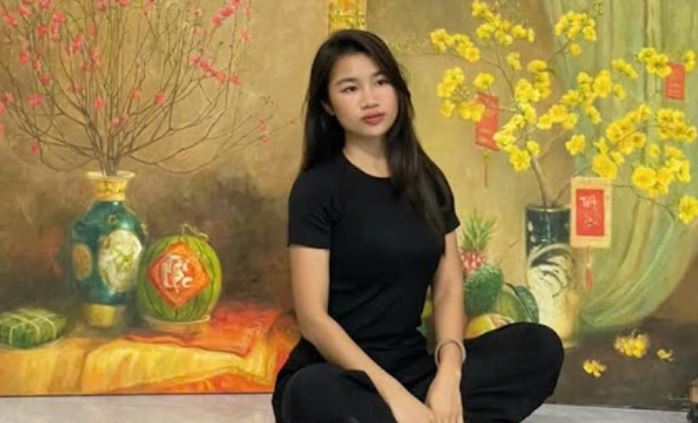
Quy Dao — Vietnamese contemporary artist whose paintings explore memory, light, and the cultural landscapes of Hanoi and Vietnam.
There is a quiet, sun-drenched magic to the way Quy Dao looks at the world.
In her paintings, everyday corners of Vietnam—weathered alleyways, sleepy street cats resting on woven chairs, bicycles leaning against fading walls, and balconies overflowing with tropical flora—are elevated into cinematic poetry. Through a remarkable mastery of light and shadow, Quy captures not simply places, but moods, memories, and moments that might otherwise disappear unnoticed.
At a time when Vietnam’s cities are changing at extraordinary speed, artists such as Quy Dao perform an important cultural role. Her work offers a visual record of the architecture, atmosphere, and everyday beauty that continue to define Hanoi’s identity. Through her paintings, she preserves fragments of a city that many residents recognise instinctively but rarely stop to observe.

Whispers of Hanoi — Sunlight dances across an ageing doorway while a solitary lantern stands watch, evoking the warmth, nostalgia, and timeless beauty of Vietnam’s historic streets.
From Public Servant to Professional Artist
Born in 1998 in Hai Duong Province, Quy’s love for art emerged early, earning recognition in school art competitions during her childhood.
Like many young Vietnamese, however, she initially followed a more conventional path. She graduated from the Academy of Public Administration and prepared for a stable professional career. For a period, she worked as a corporate secretary, developing the discipline, patience, and attention to detail that would later become evident in her artistic practice.
Yet the pull of creativity remained impossible to ignore.
During her university years, Quy devoted countless hours to studying, researching, and practising painting independently. Five years ago, she made the defining decision of her life: leaving the security of office work behind to pursue art full-time.
The decision required courage, commitment, and faith in her own abilities. Today, that faith is being rewarded.
Painting Memory Through Colour
Quy Dao’s artistic language is deeply rooted in observation and authenticity.
Rather than relying on fashionable palettes or heavily stylised interpretations, her paintings are built upon a sophisticated balance between two dominant colour worlds.
The Historic Warmth of Yellow Ochre
Across many of her works, old walls and sunlit buildings glow with rich ochres, warm ambers, and honey-coloured light. These tones immediately evoke Hanoi’s ageing facades, weathered stucco, and decades of accumulated history.
The colours are not nostalgic inventions. They are the colours of Vietnam itself—walls stained by monsoon seasons, sunlight reflected from narrow alleyways, and buildings that have quietly witnessed generations of change.
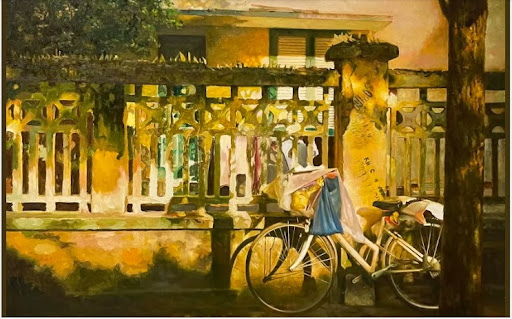
Waiting in the Afternoon — A bicycle rests quietly beside a weathered fence as late-afternoon sunlight bathes the scene in warm gold. Through everyday moments such as this, Dao Quy captures the gentle rhythms and enduring character of urban Vietnam.
The Depth of Living Greens
Balancing these warm tones are lush, organic greens.
From moss-covered stonework to dense tropical foliage hanging over doorways and courtyards, her greens feel alive and tangible. They provide both visual contrast and emotional balance, reminding viewers that nature remains intertwined with urban life, even in the heart of the city.
Together, these colours create a visual atmosphere that feels unmistakably Vietnamese.
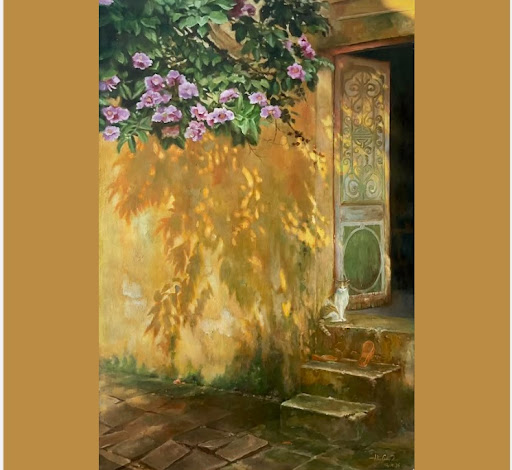
An Open Door — Sunlight spills across an ochre wall beneath cascading flowers, revealing a moment of stillness and grace. Dao Quy celebrates the intimate spaces and quiet beauty that continue to define Vietnam’s cultural landscape.
An Expression of Gratitude for a Fading World
Quy’s greatest inspiration remains Hanoi itself.
She is drawn to old streets, tiled roofs darkened by time, ancient trees, quiet courtyards, roadside cafés, and the small moments of daily life that often escape attention.
For her, painting is more than artistic expression—it is an act of preservation.
As she explains:
“My paintings are an attempt to recreate the peaceful, nostalgic moments of the capital. Through colour and lines, I hope to preserve the slow pace of life and the cultural values that are gradually fading amidst modern life.”
This perspective gives her work a quiet emotional power. Rather than criticising change, she chooses to celebrate what remains.
Growing National Recognition
Although Quy Dao has worked as a professional artist for only five years, her talent has already attracted significant attention within Vietnam’s art community.
Her work has been selected for exhibition at the prestigious Young Artists Festival on multiple occasions:
- 2022 – Old Memories
- 2024 – The Beginning of the End
- 2026 – Waiting for the Call of the Sea
She also participated in the 2024 Capital Exhibition, further cementing her growing reputation among Vietnam’s emerging contemporary artists.
The recent selection of Waiting for the Call of the Sea for the 2026 Young Artists Festival represents another important milestone in an artistic career that continues to gain momentum.
Today, her paintings can be found in private collections throughout Vietnam and increasingly among international collectors who are drawn to her ability to capture both place and emotion.
Expanding Horizons
While many collectors know Quy Dao for her evocative portrayals of Hanoi, her artistic vision continues to evolve.
Her recently selected work, Waiting for the Call of the Sea, marks a subtle expansion of both subject matter and mood. Inspired by the basket boats and coastal landscapes of Vietnam’s central provinces, the painting retains her signature fascination with light and shadow while introducing a more contemplative and atmospheric quality.
Rather than focusing on architecture and urban memory, the work invites viewers into a landscape shaped by water, reflection, and the enduring relationship between people and the sea. Its selection for the 2026 Young Artists Festival signals the growing recognition of an artist whose creative journey continues to develop beyond the streets and alleyways that first inspired her.
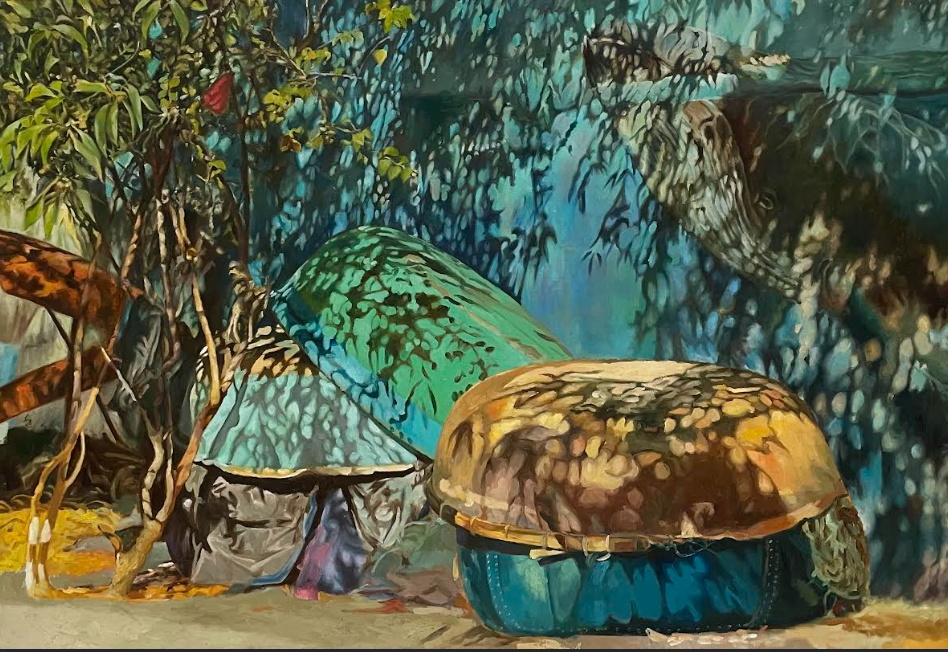
Waiting for the Call of the Sea (2026) — Selected for exhibition at the 2026 Young Artists Festival, this work draws inspiration from the traditional basket boats of Vietnam’s central coast. Through layered shadows, reflections, and marine colours, Dao Quy explores themes of memory, place, and humanity’s enduring connection to the sea.
More Than Paintings
What makes Quy Dao’s work particularly compelling is that her paintings function on two levels.
They are beautiful works of art in their own right.
But they are also historical documents.
As old neighbourhoods are renovated, as traditional architecture disappears, and as the pace of urban development accelerates, her canvases quietly preserve scenes that future generations may otherwise know only through photographs and memory.
In this sense, her work is not merely about Hanoi’s past.
It is about ensuring that Hanoi’s cultural identity remains visible within its future.
Experience Her Work
To fully appreciate the atmosphere, texture, and remarkable use of light that define Quy Dao’s paintings, they must be experienced firsthand.
Readers interested in following her artistic journey are encouraged to seek out future exhibitions and gallery showcases featuring her work.
Hanoi Trading Post is pleased to highlight artists who contribute to Vietnam’s rich cultural landscape and help preserve the stories, places, and traditions that continue to shape the nation’s identity.
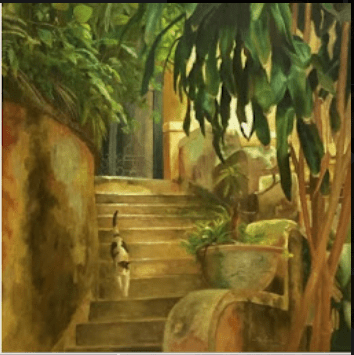
A Quiet Path Home — Through warm light, lush foliage, and everyday scenes, Dao Quy captures the peaceful rhythms of life that continue to exist beyond Hanoi’s busy streets.


Leave a comment