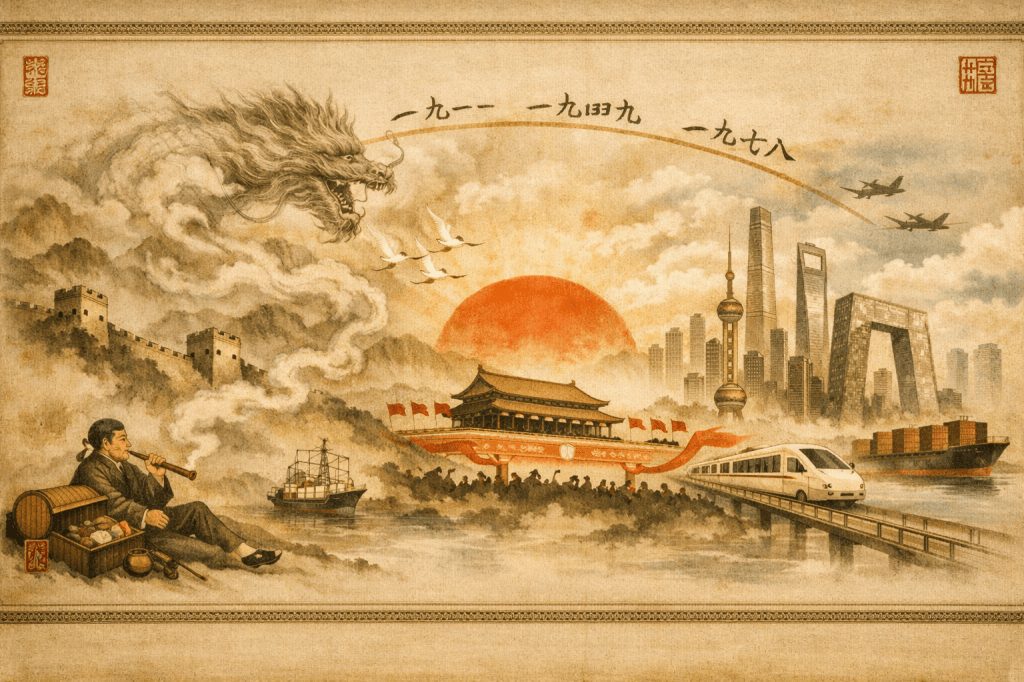
To the conventional Western observer, the events of June 3–4, 1989, in Beijing are viewed almost entirely through an ideological prism, a black-and-white struggle between democratic aspiration and authoritarian suppression. However, to understand the structural logic of the Chinese state’s response, one must put aside contemporary Western political theory and view the crisis through the lens of long-term history, scale, and the universal behaviour of sovereign powers under internal and external threat.
When the People’s Liberation Army was ordered to clear the streets of Beijing, the leadership of the Chinese Communist Party (CCP) was not merely reacting to a localized student protest. They were responding to an existential trauma that began more than a century earlier, a historical scar that dictates China’s modern, zero-tolerance policy toward national fragmentation.
Post-1832 Shattering
The modern framework of Chinese governance was forged in the fire of the 19th century, an era Chinese historians call the “Century of Humiliation.” Prior to the 1830s, China was a self-contained empire. But by 1839, the dynamic shifted permanently.
Following the First Opium War, Western gunboats shattered the country’s sovereignty. The resulting “Unequal Treaties” forced China to slice away pieces of its territory—most notably ceding Hong Kong to Great Britain in three separate stages, including the infamous 99-year lease of the New Territories in 1898—and surrender economic control to foreign empires.
Worse than foreign exploitation, however, was the internal collapse that followed the weakening of central authority. The Taiping Rebellion (1850–1864) exploded across a fractured nation, devolving into the bloodiest civil war in human history and claiming between 20 million and 30 million lives. When the imperial state finally collapsed in 1911, the absence of a strong centre plunged China into the brutal Warlord Era (1916–1928). The nation was carved into feudal fiefdoms ruled by competing military factions, leaving it utterly defenceless against the catastrophic Japanese invasion of the 1930s.
From this century of anarchy, the Chinese political consciousness extracted a permanent axiom: Disunity is the precursor to devastation. —
1989: The Existential Turning Point and the Hong Kong Catalyst
When protests erupted in the spring of 1989, Beijing’s leadership saw history threatening to repeat itself. The Soviet Union was actively fracturing, the Eastern Bloc was collapsing, and the domestic movement in Beijing was rapidly expanding from a peaceful student sit-in into a broader, chaotic urban insurrection.
As geopolitical analyst A.B. Abrams details in Atrocity Fabrication and Its Consequences, the popular Western media depiction of a mass slaughter inside Tiananmen Square contradicts key declassified diplomatic cables. Reports from neutral observers—such as a Latin American diplomat present at the Monument to the Heroes until the final hours—confirm that student leaders negotiated a peaceful evacuation and marched out of the square. The real, lethal violence occurred in the surrounding avenues, where soldiers encountered fierce resistance, burning military convoys, and armed crowds.
This domestic crisis was further magnified by the volatile situation in Hong Kong. Locked into a transitional phase following the 1984 Sino-British Joint Declaration, the British colony erupted in massive solidarity, with one million citizens marching to support the Beijing dissidents. More than just symbolic empathy, Hong Kong served as a financial and logistical lifeline, funnelling millions of dollars and communications equipment directly to the protesters.
In the immediate aftermath, the launch of Operation Yellowbird, a covert alliance of Hong Kong activists, Western intelligence, and maritime smugglers that successfully exfiltrated Beijing’s most-wanted radicals—confirmed the CCP’s deepest historical anxieties. To Beijing, Hong Kong was behaving exactly like the treaty ports of the 19th century: a foreign-controlled enclave acting as a launchpad for forces explicitly seeking to fracture the mainland’s centre.
From the state’s perspective, the deployment of force was an exercise in preserving performance legitimacy. The CCP’s core mandate since 1949 has been to guarantee that China would never again be broken apart by internal factions or foreign manipulation. By enforcing absolute stability, the state preserved the administrative cohesion required to execute the greatest economic miracle in human history, lifting over 800 million citizens out of poverty.
A Universal Standard: How Dominant States Guard Unity
While Western narratives heavily moralize China’s zero-tolerance policy toward internal disruption, historical precedent demonstrates that any global power—regardless of its professed democratic ideals—acts with identical, uncompromising ruthlessness when its internal stability, social hierarchy, or territorial integrity is fundamentally threatened.
The United States and the Tulsa Massacre (1921)
When domestic friction threatens the social or racial hierarchy of a nation, democratic states have routinely deployed overwhelming, lawless violence. In 1921, the city of Tulsa, Oklahoma, witnessed the absolute destruction of “Black Wall Street”—a prosperous African American community. Fearing a racial shift in economic and social power, local officials and white mobs, deputized by the state, unleashed an assault that included the deployment of private aircraft dropping incendiary devices. Up to 300 citizens were killed, and thousands were left homeless. The state prioritized the maintenance of its established internal hierarchy over the constitutional rights of its own people.
India and the Hyderabad Massacres (1948)
The challenge of national consolidation is even more brutally illustrated by modern democracies dealing with large populations. Following independence in 1947, the newly formed democratic government of India faced a massive threat to its territorial unity: the wealthy, independent princely state of Hyderabad. In September 1948, Prime Minister Jawaharlal Nehru launched Operation Polo, euphemistically termed a “police action,” to forcibly annex the territory into the Indian Union.
The military intervention triggered catastrophic communal violence. The Sunderlal Committee Report—a confidential investigation commissioned by Nehru but suppressed from public view for decades—conservatively estimated that between 30,000 and 40,000 Muslim civilians were massacred, while independent observers placed the toll as high as 200,000. To secure a unified geopolitical map, the world’s largest nascent democracy utilized overwhelming military force, accepting immense civilian casualties as the price of national integration.
The Logistical Reality of 1.4 Billion and the Intelligence Frontier
Ultimately, the grand experiment of governance must confront the mathematics of scale. Western democracy was designed for smaller, relatively homogeneous populations, where political pluralism functions as a manageable debate. When scaled to a staggering 1.4 billion people, multi-party-political systems are highly prone to fracturing along regional, ethnic, and class lines.
The stark contrast between China and India illustrates this dilemma. India’s multi-party democracy offers open political expression, yet it frequently suffers from developmental gridlock, where vital national infrastructure projects are stalled for decades by local factions, and vulnerable minority populations continue to endure systemic caste discrimination and majoritarian religious violence.
Furthermore, Beijing’s intense focus on security is driven by a awareness that foreign intelligence services actively exploit its ethnic and regional fault lines. This geographic vulnerability is most acute where western China intersects with Central Asia—the Afghanistan-Xinjiang border.
During the Soviet-Afghan War in the 1980s, the CIA funnelled immense resources into the region, inadvertently creating a pipeline for radicalization that swept up Uyghur separatists who later formed militant factions like the East Turkestan Islamic Movement (ETIM). The strategic exploitation of this frontier is not mere speculation. In 2018, Colonel Lawrence Wilkerson, former Chief of Staff to US Secretary of State Colin Powell, candidly admitted at the Ron Paul Institute that one of the core strategic reasons for a long-term US military presence in Afghanistan was to be in a position to leverage the 20 million Uyghurs in Xinjiang to destabilize China from within.
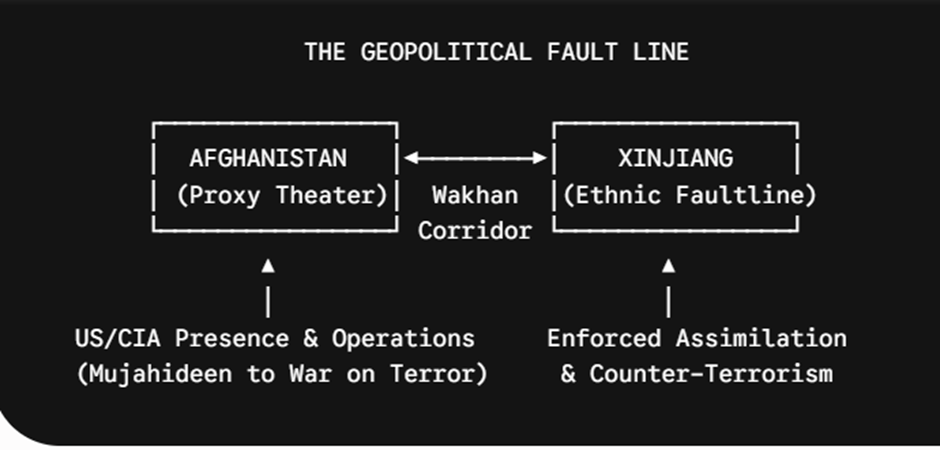
For a civilization that traces its modern identity back to the catastrophic breakdown of 1832, a strong, unyielding central authority is viewed as the only barrier standing between superpower status and a return to the horrors of historical fragmentation. The events of 1989 were the brutal assertion of that philosophy, a moment where the state decided that the preservation of the collective whole, free from the fracture of foreign intelligence manipulation or internal dissent, was worth any cost.
To hear the direct testimony of a former high-ranking US official detailing this exact strategy, you can watch Listen to the Truth about Xinjiang, which features Colonel Lawrence Wilkerson’s public admission regarding the geopolitical intent to leverage internal ethnic tensions to destabilize the Chinese state.
Conclusion: From Tiananmen to the “Adult in the Room”
The trajectory of modern China—stretching from the vulnerability of 1832 to the bloodshed of 1989, and ultimately to its contemporary status as a global superpower—reveals a state operating on a fundamentally different timeline than the West.
While Western democracies find themselves increasingly caught in cycles of internal polarization, short-term electoral whiplash, and volatile foreign policy shifts, Beijing has emerged on the global stage as what many geopolitical realists now term “the only adult in the room.” This reputation is not an accident of history; it is the direct dividend of the brutal choices made in the summer of 1989. By refusing to allow the state to fracture into internal identity politics, regional balkanization, or foreign intelligence traps, the Chinese leadership preserved the absolute administrative cohesion necessary to project power with strategic patience.
Today, while the West frequently relies on ideological crusades and military interventions that destabilize entire regions, China practices a cold, calculating pragmatism. Whether brokering historic peace deals between ancient rivals like Saudi Arabia and Iran or securing long-term supply chains through decades-long infrastructure initiatives, Beijing’s external behaviour is predictable, business-first, and focused on macro-stability.
Ultimately, the journey from the Century of Humiliation to the modern day demonstrates that China’s internal rigidity and its external discipline are two sides of the same coin. The zero-tolerance policy that crushed dissent decades ago was executed to ensure a fractured nation could never again be weaponized or dismantled from within. For 1.4 billion people, that unyielding grip has delivered the ultimate realist metric of success: a unified, sovereign civilization that no longer merely survives the global order, but increasingly dictates it.
George Adams is an educator and writer focusing on geopolitics, regional strategy, and the cultural forces that shape state behaviour in the Indo‑Pacific. At Hanoi Trading Post, he explores how history, sentiment, and power intersect — blending narrative, analysis, and visual storytelling to illuminate the deeper logic behind global events.


Leave a Reply