By George Adams
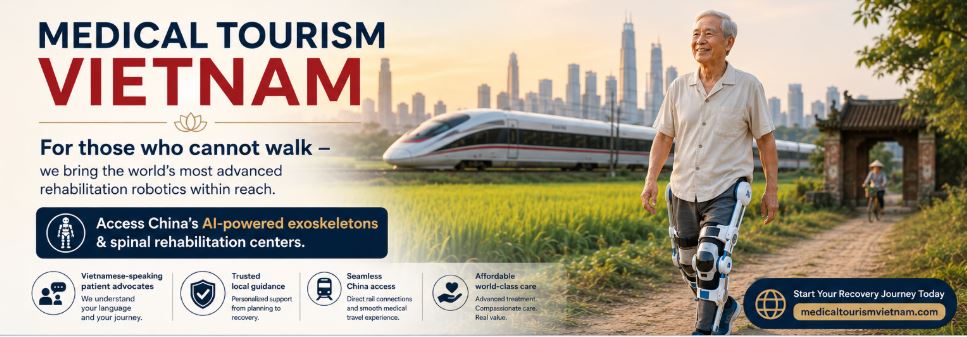
How advanced exoskeleton technology, cross-border medical cooperation, and improved rail access are transforming recovery across Asia
A New Era for Patients with Mobility Disabilities
For millions of people across Vietnam and the ASEAN region living with spinal injuries, stroke complications, herniated discs, and age-related mobility decline, the possibility of walking again is no longer a distant hope.
China has rapidly emerged as a global leader in rehabilitation robotics, combining artificial intelligence, exoskeleton technology, and large-scale clinical deployment. Today, these innovations are no longer confined to research labs—they are actively transforming patient recovery.
With the reopening of cross-border rail connections and expanding medical cooperation between China and Vietnam, access to these advanced rehabilitation solutions is becoming more practical, affordable, and accessible than ever before.
China’s Rapid Advancement in Rehabilitation Technology
China’s leadership in rehabilitation robotics reflects a combination of industrial policy, technological investment, and demographic demand.
By 2025, the global exoskeleton market is projected to exceed US$100 billion, with China representing the fastest-growing segment. Within healthcare, rehabilitation-focused exoskeletons are gaining traction in the treatment of stroke and spinal injury patients.
Technologies now in use include:
- AI-assisted lower-limb exoskeletons
- Robotic gait training systems
- Intelligent rehabilitation diagnostics
- Early-stage brain-computer interface integration
These systems are designed to support mobility recovery, improve gait function, and extend rehabilitation beyond traditional physiotherapy.
Key Chinese Companies Leading the Field:
| Company | Key Products | Applications |
|---|---|---|
| Beijing AI-Robotics (Da Ai / 大艾机器人) | “Shenxing” AI-powered knee exoskeleton; AiWalker clinical gait trainer | Rollator replacement, daily walking assistance, spinal rehabilitation |
| Fourier Intelligence (傅利叶智能) | ExoMotus™ M4 lower-limb exoskeleton; Brain-computer interface R&D | Severe spinal injury, stroke rehabilitation, clinical gait training |
| RoboCT (程天科技) | UGO lower-limb exoskeleton; Youtong pediatric/elderly models | Gait rehabilitation for elderly and spinal patients |
| SIYI Intelligence (司羿智能) | Easywalk® soft exoskeleton (China’s first) | Lightweight, flexible mobility assistance |
| Ping An Shenzhen Beiyi Rehabilitation Hospital | Exoskeleton robots + 3D gait analysis systems | “AI + precision rehabilitation” serving up to 100,000 patients annually |
Research in neural interface systems and brain-computer integration is also advancing, with reported clinical effectiveness rates approaching 78% in certain rehabilitation applications.
Expanding China–Vietnam Medical Cooperation
Cross-border healthcare cooperation between China and Vietnam has expanded significantly in recent years.
In 2025, regional authorities reaffirmed commitments to strengthening collaboration in healthcare services, particularly across border provinces. This has translated into a number of practical developments, including the introduction of Chinese medical technologies into Vietnamese hospitals and increased patient exchange between the two countries.
Chinese-supported medical systems have already been deployed in major Vietnamese institutions, reflecting growing integration between the two healthcare systems. At the same time, hospitals in China’s Guangxi region have received a substantial number of Vietnamese patients over the past decade, supported by dedicated cross-border medical coordination mechanisms.
Initiatives such as cross-border emergency medical corridors and joint healthcare programmes demonstrate that cooperation is no longer theoretical, but operational. These developments are gradually lowering barriers to access and making advanced treatment options in China more visible and accessible to patients in Vietnam and the wider ASEAN region.
a critical consideration for elderly patients with mobility disabilities and their families.
Improved Accessibility Through Rail Connectivity
Access remains a critical factor for patients considering treatment abroad, particularly those with mobility limitations.
The resumption of the Vietnam–China international railway service in 2025 has significantly improved travel options. Direct routes from Hanoi to Nanning and onward connections to major cities such as Guangzhou, Shenzhen, Shanghai, and Beijing are now operational.
Travel times have been reduced, border procedures simplified, and onward connections streamlined through China’s high-speed rail network.
For patients and families, particularly those managing physical disabilities, these developments reduce logistical barriers and make cross-border treatment more feasible.
The first step toward regaining your independence, mobility, and hope for the future.
Cost Considerations and Regional Competitiveness
China’s medical sector is increasingly competitive in terms of both technology and pricing.
In many cases, treatment costs are:
- Lower than Thailand and Malaysia
- Comparable to or slightly higher than leading Indian providers
- Supported by access to advanced robotics-based therapies
Additional advantages include:
- Accelerated medical visa processing
- Multilingual patient support services
- Dedicated international patient centres
- Integrated recovery and rehabilitation programmes
This combination positions China as a growing destination for patients seeking advanced rehabilitation at comparatively accessible cost levels.
A Shifting Landscape for Patient Access
The convergence of technological capability, policy support, and transport infrastructure is reshaping how patients in Asia access advanced healthcare.
For individuals with mobility impairments, options that were previously limited or geographically distant are becoming increasingly viable.
While access still depends on individual circumstances, the broader trend is clear: rehabilitation technologies once restricted to a handful of global centres are now expanding into regional systems, supported by cross-border cooperation and improved connectivity.
Conclusion
Rehabilitation robotics represents one of the most significant developments in modern healthcare, particularly for patients recovering from stroke or spinal injury.
China’s rapid progress in this field, combined with expanding regional cooperation and improved transport links, is creating new pathways for patient access across Asia.
As these systems continue to develop, they are likely to play an increasingly important role in shaping the future of rehabilitation and mobility recovery.
About Medical Tourism Vietnam
Medical Tourism Vietnam provides guidance and support for patients exploring cross-border treatment options, including access to specialised rehabilitation services in China and across Asia.
“Where there is technology, there is hope. Where there is hope, there is movement forward.”
This article is also associated with Medical Tourism Vietnam:
https://medicaltourismvietnam.com


Leave a comment