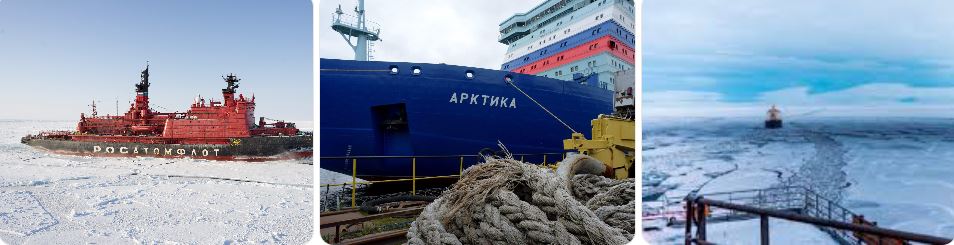
Russia’s nuclear icebreaker fleet underpins the Northern Sea Route, turning Arctic passage from seasonal gamble into sovereign-controlled trade corridor.
by George Adams
For more than a century, the Suez Canal symbolised stability in global trade: a predictable artery linking Europe and Asia under a largely US-aligned security order. That era is now ending, not with a single rupture, but through cumulative stress, conflict, and rerouting that is quietly reshaping the map of global commerce.
Instability in the Red Sea has transformed the Suez from backbone to bottleneck. Missile threats, vessel seizures, and sharply rising insurance premiums have forced shipping firms to divert traffic, extending delivery times and increasing fuel costs. The inflationary effects are already evident, particularly for energy, food, and manufactured imports, as noted by the International Monetary Fund’s assessment of Red Sea disruptions and global trade flows.¹ While political and media attention remains fixed on Middle Eastern chokepoints, a quieter but more consequential shift is unfolding further north.
Russia has operationalised the Northern Sea Route, an Arctic corridor enabled by the world’s only fleet of nuclear-powered icebreakers. Managed through Rosatom, the route can cut Europe–Asia shipping distances by up to forty per cent and reduce transit times by as much as two weeks, while bypassing the Suez Canal, the Panama Canal, and the Strait of Malacca altogether.² This is not merely a logistical innovation. It represents a reallocation of power.
Control of global trade no longer rests solely on warm-water canals, but on who can guarantee access, escort vessels, and regulate passage. Trade routes are becoming toll roads. Those who control them gain leverage not only over freight, but over pricing, timelines, and political influence. In this environment, redundancy matters more than ideology.
China understands this clearly. Its support for the Arctic corridor, framed in policy documents as part of a “Polar Silk Road,” reflects a strategic preference for diversification rather than alignment.³ Logistics hubs such as Dubai have adopted a similar posture, hedging rather than choosing sides, and engaging with multiple corridors to preserve continuity in an increasingly fragmented system.⁴
Australia, by contrast, is drifting into a position of strategic exposure.
The prospective cancellation of the Port of Darwin lease illustrates the dilemma. Framed domestically as an assertion of sovereignty, the port would not revert to Australian ownership, but would likely pass from one foreign lessee to another, potentially a US-linked private equity firm. In regional eyes, this is not autonomy but substitution. More importantly, it reinforces a pattern: long-term agreements can be abruptly restructured when geopolitical priorities shift.
That pattern did not begin with Darwin. The cancellation of the French submarine contract under the AUKUS announcement left deep diplomatic scars in Europe and raised enduring questions about Australia’s reliability as a long-cycle partner. Compensation was paid, but reputational damage lingers. In Asian commercial culture, patterns matter more than explanations. Trust is cumulative, and reversals are remembered long after legal disputes are settled.
Reputation matters in Asia in ways Australia often underestimates. Long-term consistency, predictability, and narrative control carry more weight than formal legal rights. As China is the principal trading partner for most of East and Central Asia, perceptions formed in Beijing travel quickly through regional commercial networks. Australia does not control that narrative.
Nor does it help that Australia’s domestic media culture increasingly projects suspicion or hostility toward Muslims, a signal that does not remain internal. Australia’s nearest neighbours are Muslim-majority societies, beginning with Indonesia just 130 kilometres from Australia’s northern edge, and extending across Southeast and Central Asia, including Kazakhstan and Uzbekistan. In Asian political culture, public discourse is read as national disposition. Cultural signalling accumulates alongside commercial behaviour, shaping judgments about trustworthiness and respect.
This reputational challenge is compounded by a persistent illusion of leverage. Australia possesses abundant resources, including rare earths and critical minerals, yet lacks processing capacity, refining technology, and downstream manufacturing control. In regional terms, this is upstream dependence, not strategic power. Resources without processing offer little insulation when trust erodes, and provide limited bargaining strength when value chains consolidate elsewhere.
Taken together, these dynamics point toward several plausible futures.
The most likely is quiet marginalisation. Australia experiences no dramatic rupture, but Asian partners gradually reroute logistics, investment, and long-term contracts toward more predictable jurisdictions. Darwin’s role diminishes as cargo flows favour Indonesian and Malaysian ports. LNG exports continue, but Australia becomes a price-taker in increasingly competitive Asian energy markets. Australia remains prosperous, but peripheral: in Asia, but not of it.
A more adverse outcome is managed decoupling. Australia becomes locked into a narrow, alliance-centric economic model. Asian capital shortens investment horizons, tightens exit clauses, and excludes Australia from integrated value chains. Rare earths and lithium are exported, but processing, intellectual property, and manufacturing ecosystems develop elsewhere. Australia trades heavily, but with a shrinking circle, and on terms increasingly set by others.
The least likely, but most beneficial, scenario is strategic correction. This would require Australia to reassert autonomy rather than alignment, regain narrative control in Asia, and recognise cultural signalling as a strategic variable rather than a domestic afterthought. It would also require serious investment in downstream industrial capacity, not merely extraction, and a more deliberate approach to renegotiating infrastructure arrangements without abrupt reversals.
Australia’s greatest vulnerability is not military or economic in isolation. It is reputational compounding: the accumulation of small signals into a single regional judgment. Asia rarely confronts partners publicly. It simply remembers, and reallocates trade, investment, and attention accordingly.
As trade routes freeze and ports become pressure points, Australia is discovering that resources without trust, alliances without autonomy, and geography without cultural alignment offer no protection at all.
In geopolitics, the most dangerous outcome is not punishment, but irrelevance, because it arrives quietly, without warning, and long after the decisions that caused it.
Footnotes
- International Monetary Fund, “Red Sea disruptions and global trade,” 2024, https://www.imf.org/en/blogs/articles/2024/03/07/red-sea-attacks-disrupt-global-trade?utm_source=chatgpt.com
- Rosatom, “Northern Sea Route and nuclear icebreaker fleet,” Rosatom State Atomiс Energy Corporation ROSATOM global leader in nuclear technologies nuclear energy
- State Council Information Office of the People’s Republic of China, China’s Arctic Policy, 2018, http://english.www.gov.cn/archive/whitepaper/201801/26/content_281476026660336.htm
- DP World, “Trade corridor diversification,” https://www.dpworld.com
 Hanoi Trading Post
Leave a comment