Subtitle
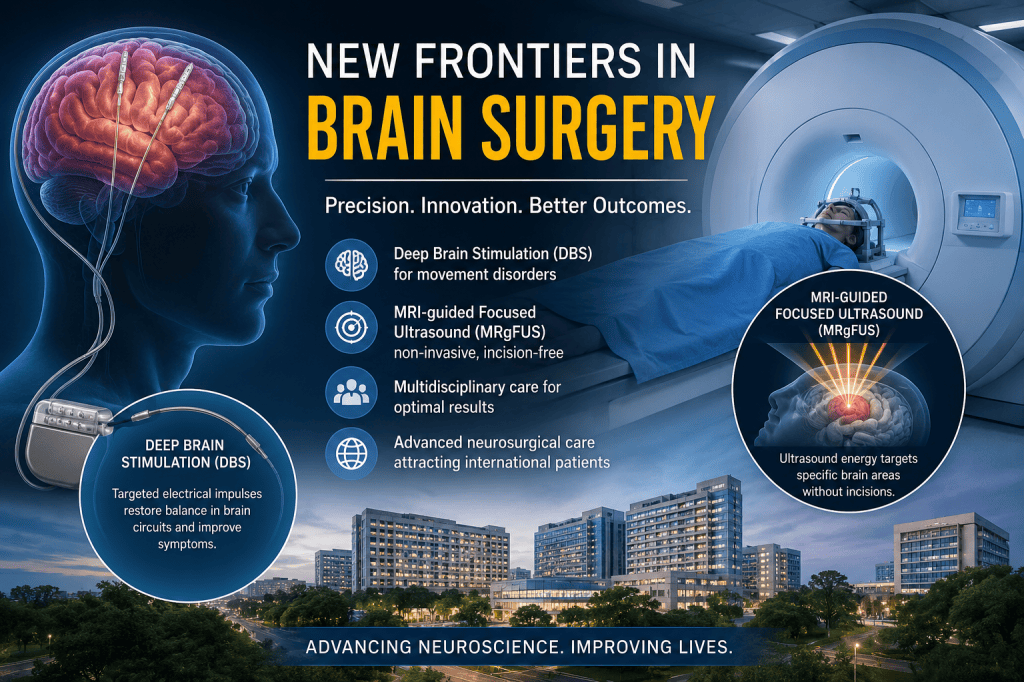
Deep Brain Stimulation and MRI-guided Focused Ultrasound are opening new possibilities for patients living with Parkinson’s disease, essential tremor and other complex neurological disorders.
For much of the twentieth century, brain surgery carried an unavoidable reputation for risk and uncertainty. Today, advances in imaging, computer navigation and precision technology are changing that perception. Around the world, neurosurgeons are increasingly able to treat movement disorders with remarkable accuracy while minimising damage to surrounding healthy tissue.
China has emerged as one of the countries investing heavily in this new generation of neurological care. Alongside its recognised expertise in oncology, transplantation and regenerative medicine, major specialist centres are now developing comprehensive functional neurosurgery programs designed to improve quality of life for patients whose symptoms have not responded adequately to medication.
Among the most significant advances are Deep Brain Stimulation (DBS) and MRI-guided Focused Ultrasound (MRgFUS)—two technologies that are reshaping the treatment landscape for selected neurological conditions.
A New Era of Functional Neurosurgery
Unlike conventional brain surgery, functional neurosurgery focuses less on removing tissue and more on restoring normal brain function by modifying abnormal neural activity.
Many neurological disorders arise because communication within specific brain circuits becomes disrupted. Rather than treating symptoms alone, modern functional neurosurgery aims to target these malfunctioning pathways with extraordinary precision.
This approach offers new possibilities for patients affected by conditions such as:
- Parkinson’s disease
- Essential tremor
- Dystonia
- Selected forms of drug-resistant epilepsy
- Other movement disorders evaluated by specialist teams
Patient suitability depends on careful neurological assessment, advanced imaging and multidisciplinary consultation.
Deep Brain Stimulation: Rebalancing Neural Circuits
Deep Brain Stimulation, commonly known as DBS, has become one of the most established treatments for carefully selected patients with advanced Parkinson’s disease and several other movement disorders.
During the procedure, neurosurgeons implant very fine electrodes into carefully identified regions of the brain responsible for abnormal movement patterns. These electrodes are connected to a small pulse generator implanted beneath the skin, typically near the chest.
Rather than destroying brain tissue, DBS delivers precisely controlled electrical impulses that help regulate abnormal neural signalling.
For many suitable patients, this may lead to improvements in symptoms such as tremor, stiffness, involuntary movement and motor fluctuations. The system can also be adjusted over time, allowing treatment to evolve as the patient’s condition changes.
MRI-guided Focused Ultrasound: Surgery Without an Incision
Perhaps even more remarkable is the emergence of MRI-guided Focused Ultrasound (MRgFUS).
Instead of making an incision, surgeons use hundreds of precisely focused ultrasound beams that converge on a tiny target deep within the brain. Guided continuously by real-time MRI imaging, the energy creates a highly localised therapeutic effect while leaving surrounding tissue largely unaffected.
Because no surgical opening is required, patients generally avoid many of the risks associated with conventional brain surgery, and recovery is often considerably shorter.
For selected patients experiencing disabling tremor, MRgFUS has become an important additional treatment option.
Multidisciplinary Care Remains Essential
While these technologies are impressive, successful outcomes depend on far more than the procedure itself.
Modern functional neurosurgery requires close collaboration between neurologists, neurosurgeons, neuroradiologists, rehabilitation specialists, anaesthetists and specialist nursing teams. Careful patient selection, detailed pre-operative assessment and long-term follow-up remain fundamental components of treatment.
This integrated approach has become a defining feature of many leading neuroscience centres throughout Asia.
Why International Patients Are Taking Notice
As international medical travel continues to evolve, patients are increasingly seeking hospitals capable of providing highly specialised care supported by advanced technology and coordinated multidisciplinary teams.
China’s expanding investment in neuroscience, combined with sophisticated imaging facilities and growing clinical experience, has contributed to increasing international interest in its functional neurosurgery programs.
For overseas patients, remote case review, multidisciplinary evaluation and coordinated treatment planning are becoming increasingly important components of cross-border healthcare.
Looking Ahead
The evolution of functional neurosurgery illustrates how rapidly medical technology continues to advance. Procedures that once required extensive surgery may now be performed with millimetre precision, and in some cases, without a single incision.
While these treatments are not appropriate for every patient, they demonstrate how precision medicine is expanding the range of therapeutic options available for complex neurological disorders.
As research continues, technologies such as Deep Brain Stimulation and MRI-guided Focused Ultrasound are likely to play an increasingly important role in helping patients maintain independence, mobility and quality of life.
Editor’s Note
This article is part of Hanoi Trading Post’s ongoing coverage of advances in healthcare, medical innovation and international treatment options across Asia. It is intended for general educational purposes and should not be interpreted as individual medical advice. Patients should always seek assessment from appropriately qualified medical specialists before making healthcare decisions.
About the Author
George Adams is the founder and editor of Hanoi Trading Post and Medical Tourism Vietnam. With decades of experience living and working across Asia, he writes on healthcare, culture, education and regional development, with a particular interest in making complex medical information accessible to international readers.
 Hanoi Trading Post