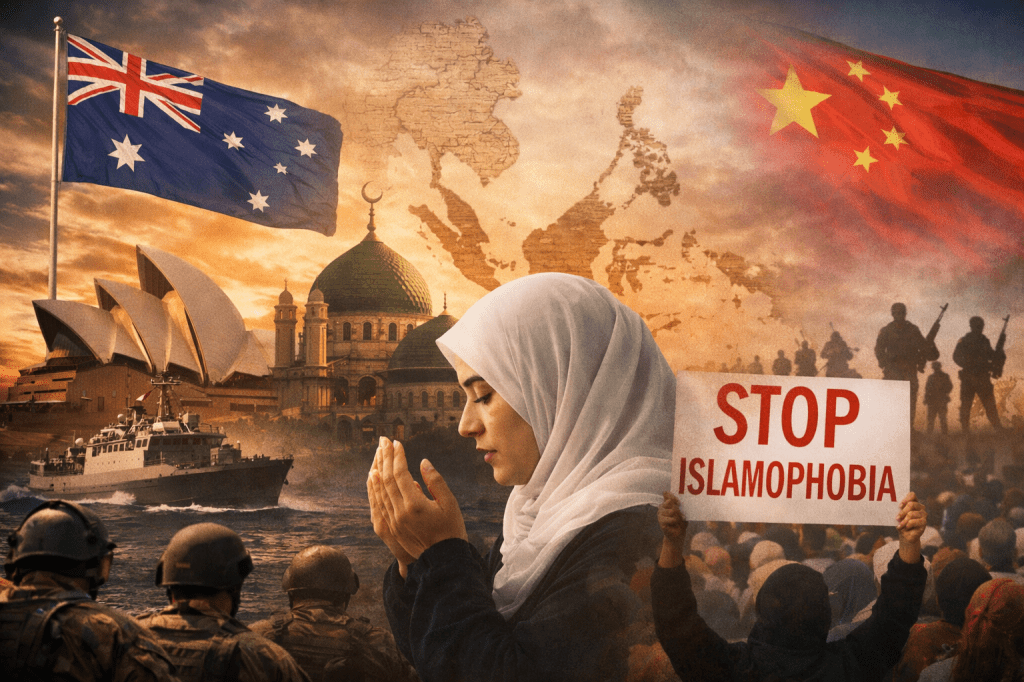
Australia enters the Asian Century with a structural contradiction at its core. It seeks deeper strategic integration with its region while continuing to send cultural signals that undermine trust among the very neighbours it depends on. In Southeast Asia and the broader Indo‑Pacific—where Islam, history, and public sentiment shape diplomacy as much as treaties—this contradiction is not abstract. It is strategic.
Australia’s future lies in Asia. But its cultural reflexes still point elsewhere.
A region defined by Islam, history, and proximity
Australia’s immediate strategic environment contains more than 680 million Muslims, stretching from Indonesia and Malaysia through South Asia to Bangladesh, Pakistan, and the Western Indian Ocean. This is one of the largest concentrations of Muslim populations anywhere on earth.
Indonesia alone has over 230 million Muslims—the largest Muslim population in the world—and its closest islands sit just 130 kilometres from Australia’s northern coastline, across the Arafura Sea and the Torres Strait. No other Western‑aligned nation sits this close to such a large Muslim‑majority neighbour.
These societies are overwhelmingly peaceful, moderate, and cooperative. Indonesia’s Nahdlatul Ulama and Muhammadiyah promote pluralism and interfaith coexistence. Malaysia and Brunei embed Islamic values within stable constitutional frameworks. Bangladesh and the Maldives maintain strong traditions of religious moderation. Across the region, governments invest heavily in deradicalisation, community cohesion, and social harmony.
In this environment, cultural respect is not symbolic. It is a strategic requirement.
Domestic incidents in Australia—such as police confronting Muslims while praying—are therefore not interpreted as isolated events. They are read through religious solidarity, historical memory of colonial policing, expectations of respect toward Islamic practice, and public sentiment that governments cannot ignore.
For neighbours only a short sea crossing away, these signals matter.
A long history of Islam in Australia—and a long history of Islamophobia
Islam has been present in Australia for centuries. Makassan fishermen from Sulawesi traded with Indigenous communities in northern Australia from at least the 1700s. Afghan cameleers were essential to the development of inland Australia in the 19th century. Muslim communities have been part of the national fabric long before Federation.
Yet despite this history, Islamophobia has been a recurring feature of Australian public life. National studies across the past two decades have documented rising anti‑Muslim prejudice, disproportionate targeting of visibly Muslim women, spikes in hate incidents during global conflicts, negative media framing of Muslims, and political rhetoric that inflames public sentiment.
These cultural patterns extend beyond religion. For decades, parts of Australian media and popular culture have portrayed Asian women through sexualised stereotypes, “massage girls”, “mail‑order brides”, or workers in the sex industry. These depictions reflect a deeper hierarchy in which Asia is feminised, exoticised, and treated as subordinate. In Southeast Asia, where women hold senior political, academic, and religious leadership roles, such stereotypes reinforce the perception that Australia still views the region through a colonial and gendered lens.
Strategic partnerships require cultural literacy
Australia’s new defence pact with Indonesia is one of the most significant security agreements in decades. It commits both nations to deeper military cooperation, regular strategic consultations, and shared responses to regional threats.
But strategic cooperation in Southeast Asia is built on trust, and trust is built on cultural respect. Indonesia’s political class, religious leaders, and civil society all monitor how Muslims are treated abroad. A policing incident in Sydney can ripple into perceptions of Australia’s reliability as a partner. In a region where symbolism is strategy, cultural missteps become strategic liabilities.
Immigration as a capability engine—and a regional signal
Immigration is one of Australia’s greatest potential strengths. More than 30% of Australians are born overseas, one of the highest rates in the world. Asian migration—particularly from India, China, the Philippines, Vietnam, Malaysia, and Indonesia—has reshaped Australia’s workforce and cultural landscape.
In Asia, immigration is seen as a capability tool, a driver of innovation, and a mechanism for regional integration. Singapore, Malaysia, and South Korea all use immigration strategically to build national capacity.
Australia, however, often frames immigration as a political problem. This framing is noticed in the region. When Australia debates immigration in negative terms, it signals discomfort with Asian integration at the very moment it needs deeper regional ties.
A capability‑focused immigration policy would align Australia with the practices of its neighbours and strengthen its standing in the region.
The Darwin Port reversal and the China reality
The Albanese government’s intention to unwind the Darwin Port lease highlights how past short‑term decisions become long‑term strategic liabilities. The port is a gateway to northern Australia and the maritime approaches shared with Indonesia and Timor‑Leste.
But the deeper issue is China’s centrality. Every major Asian economy trades far more with China than with Australia. China dominates regional supply chains, rare‑earth processing, and industrial capacity. Australia’s economic future—especially in minerals and energy—still depends on China’s tolerance and market behaviour.
ASEAN states see a country economically tied to China, culturally tied to the West, and geographically tied to Asia—yet still struggling to reconcile these identities.
AUKUS and the unintended opening for Russia
AUKUS was presented domestically as a stabilising force, but across Southeast Asia it was widely interpreted as a break with the nuclear‑free Pacific tradition, a reaffirmation of Australia’s Western military identity, and a move that excluded ASEAN from regional security architecture.
Indonesia and Malaysia expressed concern not only about nuclear propulsion but about the strategic message: Australia was doubling down on Western alignment without regional consultation.
This created diplomatic space for Russia. Moscow has since expanded its courtship of Indonesia through civil nuclear energy cooperation, offers of reactor technology, deeper defence ties, and discussions about strategic access in eastern Indonesia (Irian Jaya / Papua).
Whether these arrangements materialise is less important than the fact they are being explored. Their emergence signals a broader regional recalibration triggered by Australia’s choices.
AUKUS did not freeze the region into a Western orbit. It encouraged some states to diversify their partnerships.
Western alignment in a region shaped by Islam
Australia’s reaffirmation of “shared values” with the United States, especially through AUKUS, reinforces its Western strategic identity. But in Southeast Asia, historical memory is long. The region remembers the Vietnam War, the invasions of Iraq and Afghanistan, Western support for authoritarian regimes during the Cold War, and the consequences of Western military interventions.
This context becomes sharper when Australia welcomes the President of Israel at a time when several Southeast Asian states have severed or downgraded ties with Israel and support international legal proceedings related to Gaza. For Indonesia, Malaysia, and Brunei, this is not a marginal issue. It is central to public sentiment and national identity.
Australia’s political and media alignment on this issue may be domestically uncontroversial, but regionally it is a cultural and diplomatic signal.
A strategic and cultural crossroads
Australia’s challenge is not capability. It is coherence. The country wants to be a trusted partner in the Asian Century while continuing to behave, speak, and signal as if it sits outside the region looking in. Domestic incidents, policing decisions, political rhetoric, alliance language, nuclear choices, and now the embrace of Israel’s president all carry weight in a neighbourhood shaped by Islam, history, and proximity. They shape trust. They shape perception. They shape alignment.
A culturally literate foreign policy is not a soft add‑on to strategy. It is strategy. And without it, Australia will continue to push its neighbours toward alternative partnerships — whether with China, Russia, or any other power willing to treat them with respect.
What a culturally literate Australian foreign policy would look like
A culturally literate approach begins with recognising that Australia’s closest neighbours are peaceful, moderate Muslim societies whose political legitimacy is tied to public sentiment, religious respect, and historical memory. In this environment, cultural signals are strategic signals.
A culturally literate foreign policy would include:
- respectful domestic conduct toward Muslim communities
- regional consultation as the default for major decisions
- immigration framed as capability, not crisis
- diplomatic alignment that accounts for regional sentiment
- recognition of proximity and demographic reality
- awareness of strategic ripple effects triggered by AUKUS
A culturally literate foreign policy does not require Australia to abandon its alliances. It requires Australia to understand how those alliances — and the company it keeps, including Israel — are interpreted by the region it claims to value.
The choice ahead
Australia stands at a crossroads. It can continue to behave as a Western outpost adjacent to Asia, sending cultural signals that undermine its strategic ambitions. Or it can align its identity with its geography, recognising that respect, sensitivity, and regional literacy are the foundations of influence in a neighbourhood shaped by Islam, history, and proximity.
The Asian Century will not wait for Australia to resolve its contradictions. The region is already moving. The question is whether Australia chooses to move with it — or be left behind.
References & Sources
- Pew Research Center — Global Muslim Population Estimates
- Indonesian Ministry of Religious Affairs — National Demographic Data
- Australian Human Rights Commission — Islamophobia in Australia Reports
- Australian Bureau of Statistics — Immigration and Population Data
- Australian National University — Makassan Contact with Northern Australia
- Lowy Institute — Southeast Asia Public Opinion Surveys
- ASEAN Secretariat — Regional Security Outlook
- Pacific Islands Forum — Nuclear‑Free Pacific Declarations
- International Atomic Energy Agency — Civil Nuclear Cooperation Statements
- UN General Assembly Voting Records — Gaza‑Related Resolutions
- Indonesian Ministry of Foreign Affairs — Statements on AUKUS
- Malaysian Ministry of Foreign Affairs — Statements on AUKUS and Gaza
 Hanoi Trading Post
Leave a comment