
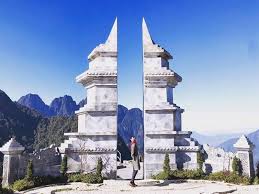
Nestled in the Hoang Lien Son range of northern Vietnam, there is a place where the earth seems to strain towards the heavens. This is Tram Ton Pass, aptly named “Heaven’s Gate.” As Vietnam’s highest mountain pass, soaring to 1,900 meters above sea level, it is more than a geographic marvel; it is a threshold between worlds, steeped in mist, myth, and breathtaking vistas.
For many travelers, the journey to Heaven’s Gate begins in the charming, cloud-draped town of Sapa. A crucial piece of advice from seasoned explorers? Do not be deterred by Sapa’s mist. The microclimate here is a trickster. While Sapa may be shrouded in a cool, mystical veil, just a short, winding drive up the pass can lead you into brilliant, heart-stopping sunshine. The temperature often rises noticeably as you ascend, as if you are literally climbing out of the earthly realm and into a brighter, celestial domain.
Why “Heaven’s Gate”? The Legends in the Mist
The name is not merely a metaphor for the sublime views. It is rooted in the local lore of the H’mong and Dao people, for whom these mountains are alive with spirits. Two intertwined legends persist, giving the pass its poetic and powerful identity.
The first tells of a tragic love between a fairy and a mortal woodcutter. Forbidden from being together, they were separated by the heavens. The fairy was pulled back to the sky, but in her grief, she wept so profusely that her tears carved a waterfall down the mountainside—today’s majestic Love Waterfall, located in the shadow of the pass. Tram Ton Pass, the highest point nearby, is said to be the place where the gate between her world and his was finally sealed, a permanent reminder of their eternal divide.
The second legend is of a more perilous nature. The pass lies on the flank of Mount Fansipan, known as “the Roof of Indochina.” Locals believed this peak was the home of powerful, sometimes treacherous, mountain spirits. The thick, rolling fog that famously engulfs the pass was seen not just as weather, but as the breath of these spirits—a protective veil hiding their domain. To pass through Tram Ton was to cross this spiritual boundary, to move from the familiar human world into the sacred, unpredictable realm of the gods. Surviving the journey, especially in the old days on foot, meant you had been granted passage by the spirits themselves.
The Journey Through the Gate
The modern drive along the pass is an experience of dramatic contrasts. One moment you are in dense, primeval jungle, the next you emerge onto a rocky outcrop with a view that stretches for eternity. On a clear day, you can see the entire valley unfurling below, a tapestry of terraced rice fields, winding rivers, and distant villages. To the east, the arid, rain-shadow valley of Lao Cai basks in sunlight; to the west, the lush, humid Sapa valley simmers in cloud. You are standing on the climatic divide of northern Vietnam.
A popular stop just 3km before the highest viewpoint is the Thach Bac (Silver) Waterfall. While it is a compulsory and often busy stop for tour groups, the 200-meter cascade is undeniably powerful and beautiful. Its milky waters rushing down the dark rock are a fitting prelude to the grandeur of Heaven’s Gate. The savvy traveler visits both, understanding that the waterfall represents the earthly beauty of the region, while the pass offers the promised celestial reward.
Standing at the Threshold
To visit Tram Ton Pass is to participate in its legend. You arrive perhaps in Sapa’s earthly fog, navigate the spirits’ breath on the winding road, and finally break through to the sun-drenched summit. You look out from the “gate” and understand the name completely. It is a feeling of transcendence, of having climbed to the very edge of the map.
So, go. Brave the changing weather, listen for the whisper of the fairy’s tears in the waterfall’s roar, and respect the old spirits of the mountain. At Heaven’s Gate, Vietnam doesn’t just show you a view—it offers you a story written in clouds, stone, and sky, and invites you to become a part of it.
 Hanoi Trading Post
Leave a comment