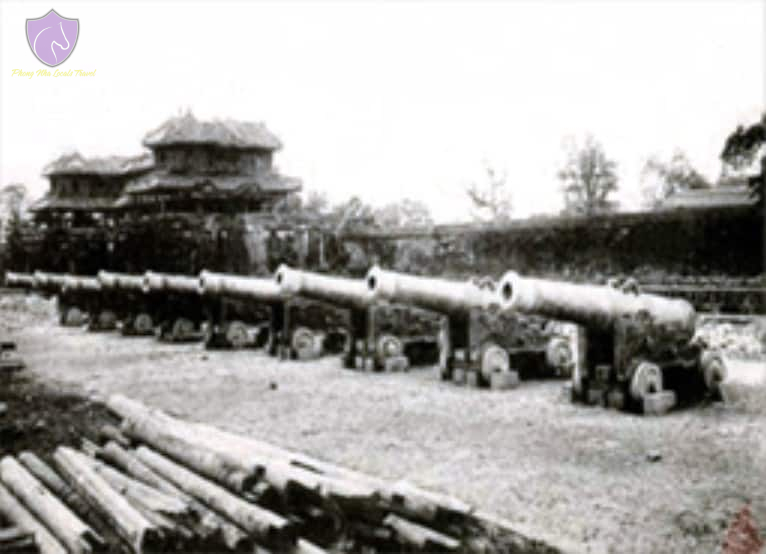
Nestled within the historic grounds of the Hue Imperial Citadel, beyond the grand gates and intricate palaces, stand nine formidable bronze cannons. To the casual observer, they are relics of war, but to those versed in the ancient philosophies that shaped the Nguyen Dynasty, they are far more. They are the Sacred Cannons, eternal guardians embodying the Five Fundamental Elements of the universe and representing the supreme power of the emperor.
More Than Weapons: Symbols of Cosmic Harmony
Commissioned by Emperor Gia Long after his unification of Vietnam in 1802, these cannons were never meant to see battle. Their creation was a profound symbolic act. Cast from the bronze of captured enemy weapons, they were transformed from instruments of conflict into emblems of peace, order, and imperial authority.
According to the ancient East Asian worldview, the universe is composed of five elements: Metal, Wood, Water, Fire, and Earth. These elements interact in cycles of creation and balance, governing all natural phenomena and human affairs. The Nguyen emperors, ruling by the “Mandate of Heaven,” sought to align their kingdom with this cosmic order. The nine cannons were their physical declaration of this harmony.
The Four Seasons and the Five Elements
The cannons are divided into two groups, each with specific names and elemental associations that link imperial power to the natural world.
| Cannon Group | Vietnamese Name (Translation) | Represented Element | Symbolic Meaning & Association |
|---|---|---|---|
| The Four Seasonal Cannons (4 Cannons) | Xuân (Spring), Hạ (Summer), Thu (Autumn), Đông (Winter) | Wood, Fire, Metal, Water | The cyclical, unchanging order of time and nature, over which the Emperor presides. |
| The Five Element Cannons (5 Cannons) | Kim (Metal), Mộc (Wood), Thủy (Water), Hỏa (Fire), Thổ (Earth) | Metal, Wood, Water, Fire, Earth | The fundamental substances of all creation, symbolizing the comprehensive and foundational power of the empire. |
This system of nine cannons (four seasons + five elements) is deeply significant. In Vietnamese and Chinese cosmology, the number nine is the ultimate yang number, symbolizing the heavens, eternity, and the supreme status of the emperor. By grouping them this way, the dynasty proclaimed that its power was as eternal as the seasons and as all-encompassing as the elements themselves.
Architectural Guardians of the Citadel
Their placement within the Citadel was meticulously planned according to feng shui principles. Originally positioned at key locations—including the Imperial City’s main gates (Ngọ Môn) and the Royal Palace—they served as spiritual protectors. They were believed to ward off evil spirits, malevolent energies, and military threats, using their symbolic power rather than their firepower to defend the seat of the Mandate of Heaven.
Alongside the cannons, another set of bronze masterpieces reinforces this elemental symbolism: the Nine Dynastic Urns housed in the To Mieu Temple complex. Cast under Emperor Minh Mang, each urn is dedicated to a different Nguyen emperor and is adorned with symbols of one of the five elements—mountains (Earth), waves (Water), fire (Fire), etc. Together, the cannons and the urns create a powerful symbolic narrative: the urns hold the essence of the nation and its ruling lineage, while the cannons externally protect that legacy from all harm.
From Symbol to Survivor: Witness to History
The tragic irony is that these symbolic guardians could not protect the Citadel from the devastation of the 1968 Tet Offensive. As the Forbidden Purple City was reduced to ruins, the cannons stood witness. Their survival amidst the rubble transformed their meaning once more. Today, they are not just symbols of imperial power, but also silent witnesses to modern conflict and resilience.
Experiencing the Legend Today
For visitors exploring the UNESCO World Heritage Site, seeking out the cannons offers a deeper layer of understanding:
- Where to Find Them: Several cannons are displayed near the Flag Tower and at key points along the citadel walls.
- A Moment for Reflection: Look for the intricate inscriptions and their given names. Consider how they represent a philosophy where statecraft, nature, and cosmology were inseparable.
- The Full Picture: Visit the Nine Dynastic Urns at the To Mieu complex to see the complete story of elemental symbolism crafted by the Nguyen emperors.
The Sacred Cannons of Hue transcend their military form. They are a metaphor in bronze, revealing a worldview where power was legitimized through harmony with the cosmos. They remind us that Hue’s true majesty lies not only in its restored palaces but in the profound and poetic intellect that built them—an intellect that sought to forge an empire in the image of the universe itself.

 Hanoi Trading Post
Leave a comment