
Introduction
Nestled in the northern plains of Vietnam, the ancient spiral citadel of Cổ Loa stands as a silent witness to one of the nation’s most foundational and heartbreaking myths. More than just an archaeological marvel, it is the stage for a story of divine power, devastating betrayal, and a king’s final, desperate plunge. At the heart of this legend lie three iconic elements: a magic crossbow, a princess’s beheading, and a king’s leap into a well. Each act forces us to confront a centuries-old question: Who was truly responsible for the fall of the kingdom of Âu Lạc? Was the princess, Mỵ Châu, a traitor or the ultimate victim?
The Divine Gift: The Claw and the Crossbow
After establishing his capital at Cổ Loa with the guidance of a golden turtle god (Kim Quy), King An Dương Vương was gifted a talisman: the turtle’s own claw. Forged into the trigger of the king’s crossbow, this sacred object transformed it into a weapon of invincibility. A single bolt, when fired, would multiply into a thousand, obliterating any invading army. The crossbow became more than a weapon; it was the physical embodiment of the kingdom’s sovereignty and divine mandate. Its power was absolute, but its security was tragically human.
The Betrayal and the Theft
The northern warlord, Triệu Đà (Zhao Tuo), unable to conquer Âu Loa by force, resorted to guile. He proposed a political marriage between his son, Trọng Thủy, and An Dương Vương’s daughter, Princess Mỵ Châu. A love blossomed, but it was built on a foundation of deceit. Blinded by affection and trust, Mỵ Châu eventually revealed the secret of the crossbow’s power to her husband. In a pivotal, treacherous moment, Trọng Thủy swapped the magic claw for a counterfeit. The divine protection of Âu Lạc was stolen not in battle, but in the intimacy of the marital chamber.
The Fall: Beheading and the King’s Despair
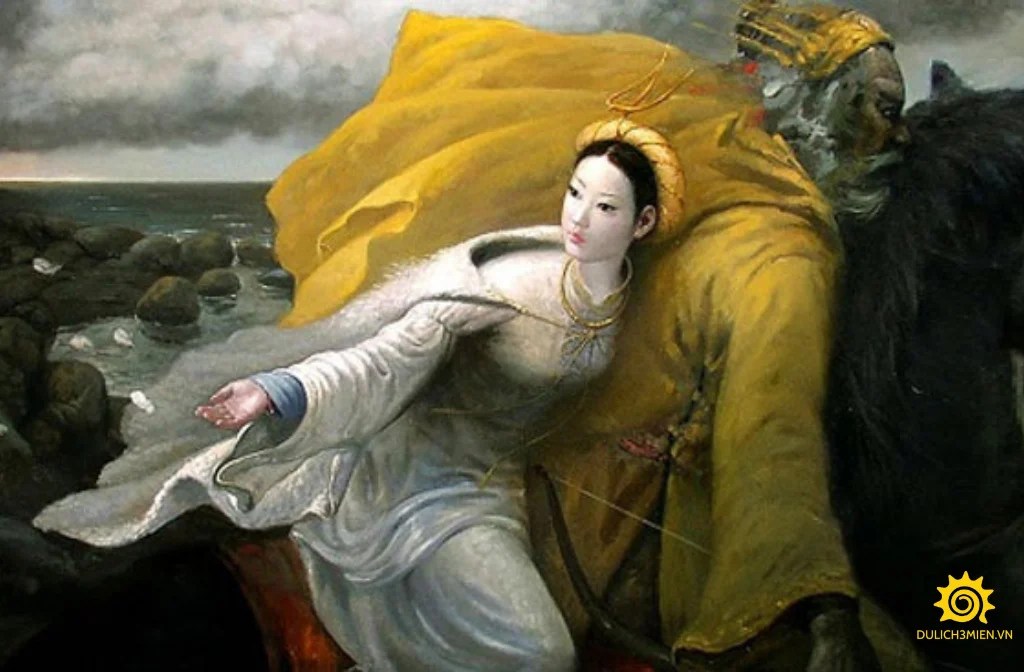
When Triệu Đà’s army finally marched, the once-invincible crossbow failed. The kingdom fell in an instant. As An Dương Vương fled on horseback with his daughter behind him, the myth reaches its crescendo of tragedy and revelation.
The golden turtle god suddenly reappeared, its voice cutting through the chaos: “The enemy is right behind you!” The king looked back and saw the truth—Mỵ Châu, out of love or naivete, had been scattering feathers from her goose-down robe along their path, creating a trail for her pursuing husband to follow.
In a fit of rage, grief, and utter betrayal, the king drew his sword. The legend states he beheaded his own daughter on the spot. Her blood flowed, and where it touched the earth, pearls formed—a symbol of her purity corrupted and her story crystallized into tragedy.
The Final Act: The King’s Leap into the Well
With his kingdom lost and his beloved daughter dead by his own hand, An Dương Vương was a king without a realm, a father without a child. The myth offers a haunting conclusion: pursued to the water’s edge, the golden turtle god emerged once more, leading the broken king into the depths. In some versions, he jumped into a well, and the turtle carried him eternally into the ocean, away from the mortal world he failed to protect. This final act is not just a suicide, but a mystical dissolution—the king, his power, and his legacy swallowed by the waters from which the divine turtle first came.
Was the Princess to Blame?
This is the legend’s enduring moral knot.
- The Case Against Her: She violated the sacred trust of the state. Her actions—revealing the secret and marking the trail—directly caused the kingdom’s fall. In a Confucian framework of duty, she placed personal love above national security, committing high treason.
- The Case for Her Innocence: Mỵ Châu was a young woman caught in a political scheme far beyond her understanding. She was a pawn in her father’s diplomacy and her husband’s deception. Her “crime” was profound trust and love, manipulated by the men around her. She died not as a traitor, but as the final, sacrificial victim of the conflict.
The true tragedy may lie in the king’s fatal flaw. The legend suggests that divine power is useless without human wisdom. An Dương Vương secured a magic crossbow but failed to secure his court. He accepted a political marriage but was blind to its peril. He built an impenetrable spiral fortress but could not protect the human heart within it. In the end, he punished the symptom (his daughter’s betrayal) but could not face the cause: his own failure of discernment and strategy.
Conclusion
The legend of Cổ Loa, with its magic crossbow, bloody beheading, and royal suicide, endures because it is more than a story of how a kingdom fell. It is a profound exploration of the tensions between love and duty, trust and vigilance, divine favor and human error. The spiral of the citadel mirrors the inescapable spiral of fate that ensnared the king, the princess, and the prince. To ask if the princess was to blame is to ask where the chain of responsibility truly begins—a question that echoes through the corridors of history and the ruins of Cổ Loa to this day.
 Hanoi Trading Post
Leave a comment